

When to Fire Your Positioning: A Decision Framework for GTM Leaders
Most positioning failures aren't bad work. They're stale work no one had the authority to retire.
WRITTEN By Fluvio consultant, Kina Lara
A CMO walks into a Q2 review with pipeline up and win rates flat for three quarters. The CRO blames sales tooling, the VP of Demand Gen blames lead quality, and someone proposes a messaging refresh. Six months and a relaunched website later, win rate is still flat — and no one has asked the question that matters most: is the positioning still working?
This scenario plays out more often than most leadership teams recognize, and the response almost always misses the actual problem.
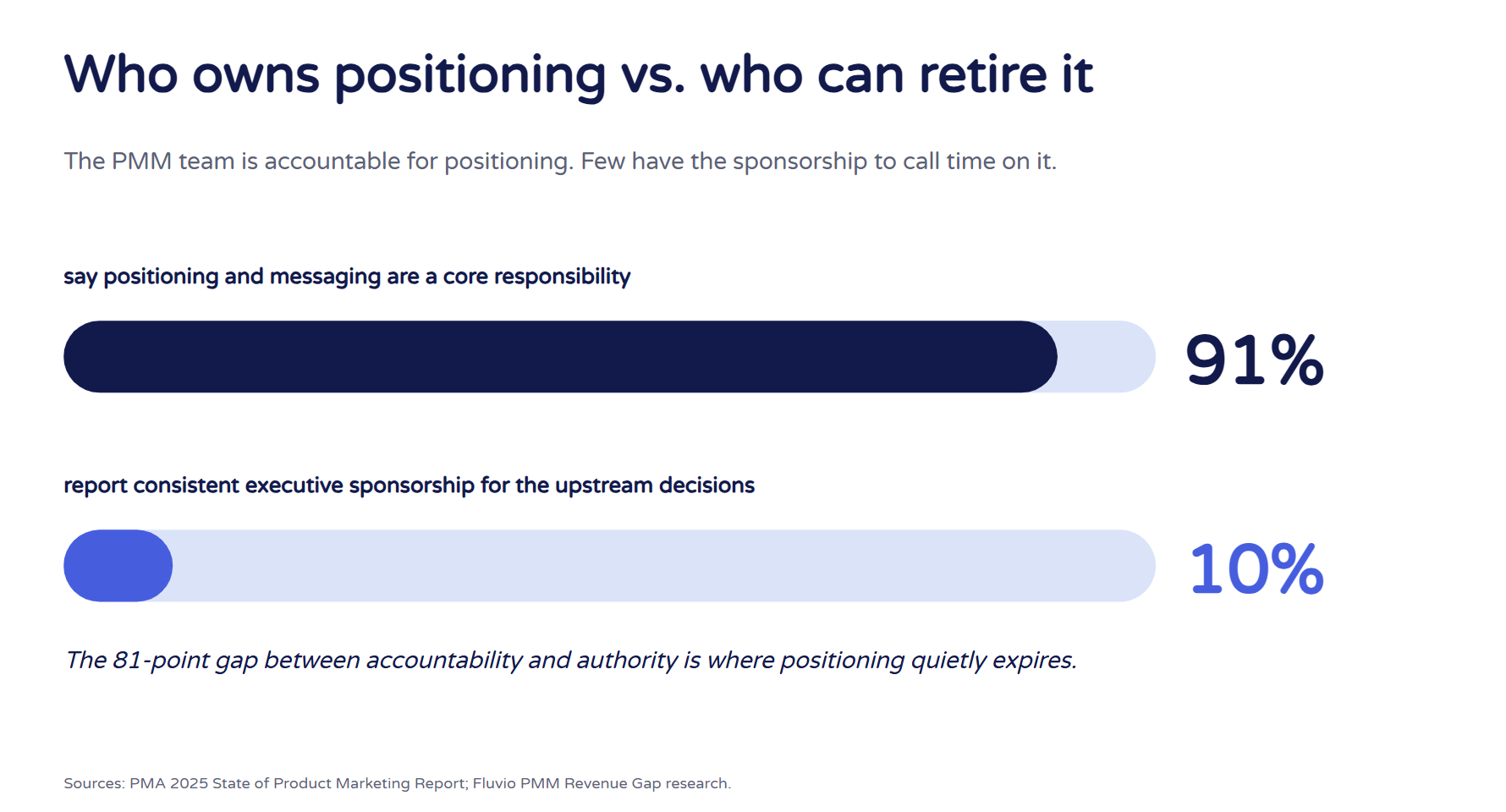
91% of product marketers say positioning and messaging are a core responsibility. Only 10% report consistent executive sponsorship for the upstream decisions that determine whether positioning still works. So the people who can see positioning failing are rarely the people who can retire it. PMMs own the work; the call to revisit it belongs to the CMO, and in the distance between those two jobs, stale positioning goes unaddressed for years.
Why this call rarely gets made
Knowing when to scrap positioning is more valuable than knowing how to write it, but scrapping positioning is uncomfortable in ways that compound. It implicates past decisions, signals that something once working has stopped working, and opens the door to a longer, harder conversation about the company's place in the market.
Faced with that prospect, the path of least resistance is the lighter intervention: a messaging refresh, a website rebuild, a sales deck rework. Each can be useful in its own right, but none is the same as a positioning decision.
Most companies treat positioning as a one-time exercise: build it, refine it, leave it alone until something obvious breaks. By the time something obvious does break, the cost has been compounding for years.
Categories collapse and reform, ICPs drift as companies grow, sales teams find their own workarounds, and buyers learn a new vocabulary the company hasn't caught up to. Positioning that earned its keep in 2024 erodes silently in 2026, and no one is empowered to call time on it.
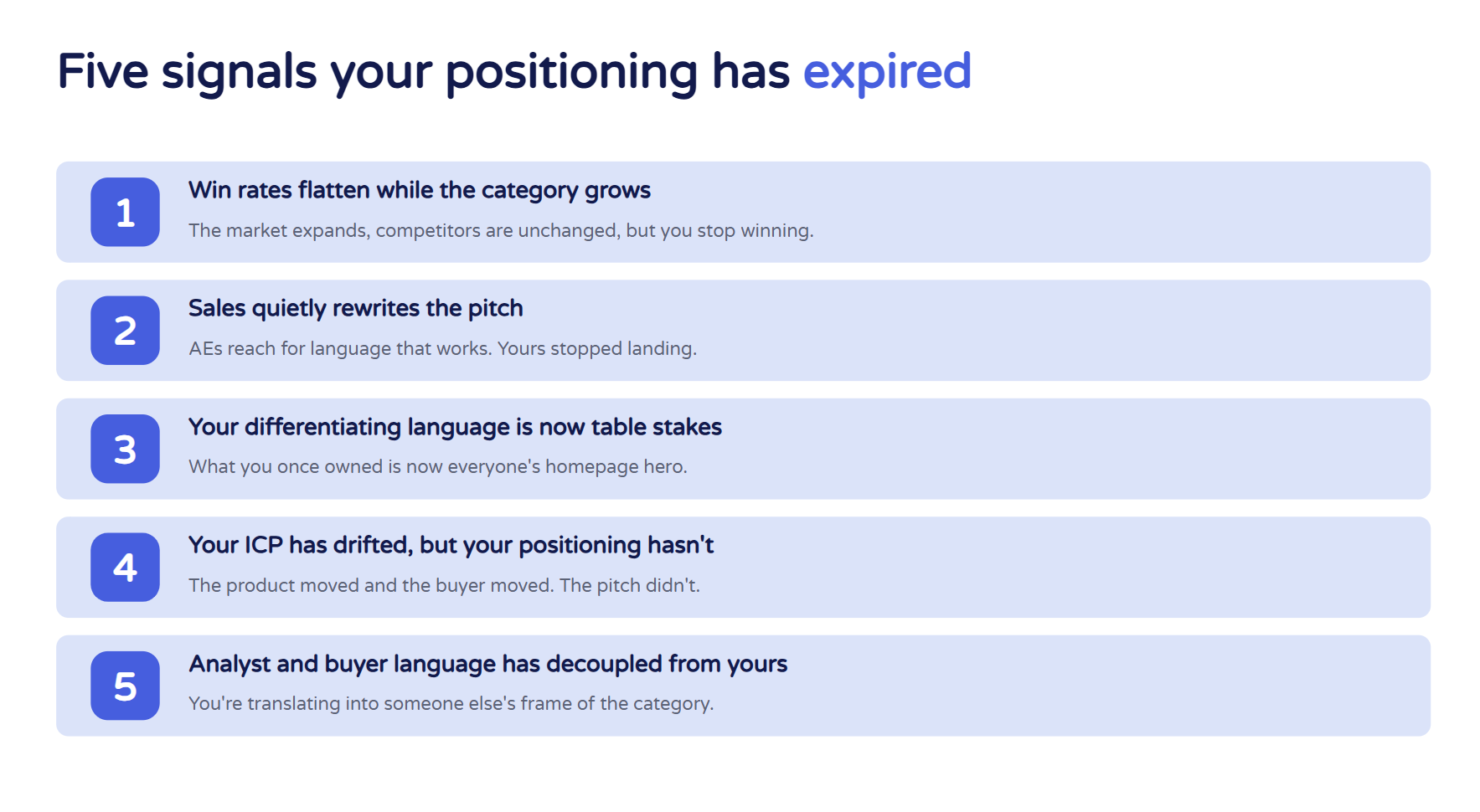
Five signals your positioning has expired
These are the patterns we see across Fluvio engagements when teams ask us to help them rewrite messaging, and we discover the messaging is not the problem.
1. Win rates flatten while the category grows
The market is expanding and your competitors are unchanged, but your win rate against them is no longer improving. In some quarters, it is dropping.
When a rising tide isn't lifting your boat, your differentiation isn't differentiating. You're competing on category benefits everyone now claims, and the positioning has stopped doing the work of separating you.
How to check. Pull win rate trends over the last six quarters and overlay them on category growth (analyst data, public pipeline data from comparable competitors). If the lines have diverged, it is a signal.
2. Sales quietly rewrites the pitch
Listen to a sample of recent sales calls and compare what AEs say to what your messaging framework says. If the two no longer match, your field has stopped using yours.
Sales teams are pragmatic; they reach for whatever language works. When the official positioning stops landing in conversations with buyers, AEs improvise, and that improvisation is data.
How to check. Pull ten recorded discovery and demo calls from your top three AEs. Compare the words they use to introduce your product to the words in your messaging brief. The drift is usually obvious.
3. Your differentiating language is now table stakes
Five years ago, "AI-powered" was a position; today it is a baseline expectation, alongside "platform," "real-time," "developer-first," and most of what was once distinctive in B2B SaaS.
If competitors and adjacent players have adopted the language you used to own, you haven't been copied so much as absorbed, and the positioning is no longer visible.
How to check. Read the homepage hero of your three closest competitors and three players from adjacent categories. Count how many use language identical or near-identical to yours.
4. Your ICP has drifted, but your positioning hasn't
Companies grow into new segments, move upmarket, sunset products, and acquire others. Most of the time, the positioning still speaks to the buyer the company was selling to two stages ago.
This is a common failure mode at Series B and later. The product has changed and the buyer has changed, but the pitch has not. Internal teams adjust silently, and new customers find the company despite the positioning, rather than because of it.
How to check. Compare the persona document referenced in your current messaging framework to the actual buyer profile of deals closed in the last two quarters. If they don't match, the positioning is pointed at the wrong person.
5. Analyst and buyer language has decoupled from yours
Read three recent Gartner or Forrester briefs in your category, scan five customer review sites, and listen to how prospects describe what you do during discovery calls.
If the words analysts and buyers use to describe your category no longer match the words you use, you've stopped setting the narrative. You're translating yourself into someone else's frame, and that is an expensive position to hold.
How to check. Take the top three phrases from your most recent positioning doc. Search them in the most recent analyst report covering your category. If they don't appear, or appear in different contexts than yours, the gap is real.
Why this is hard to see from inside
Positioning erosion is invisible from the executive seat for a specific reason: the people closest to the symptoms are the ones least empowered to name them.
PMMs see the messaging drift, AEs see the pitch drift, and customer success sees the ICP drift. Each team adjusts in real time, and each treats the adjustment as a tactical fix rather than a structural signal.
By the time the symptoms aggregate into a number leadership can see — flat win rate, stalled pipeline conversion, a quarter of missed expansion — the positioning has been broken for eighteen months. The cost has been compounding the entire time, distributed across a hundred small adjustments no one logged.
This is why a messaging refresh feels like progress. From the executive seat, with limited diagnostic information traveling upstream, it's often the most visible intervention available, even when it isn't the right one.
Refresh, reposition, or recategorize
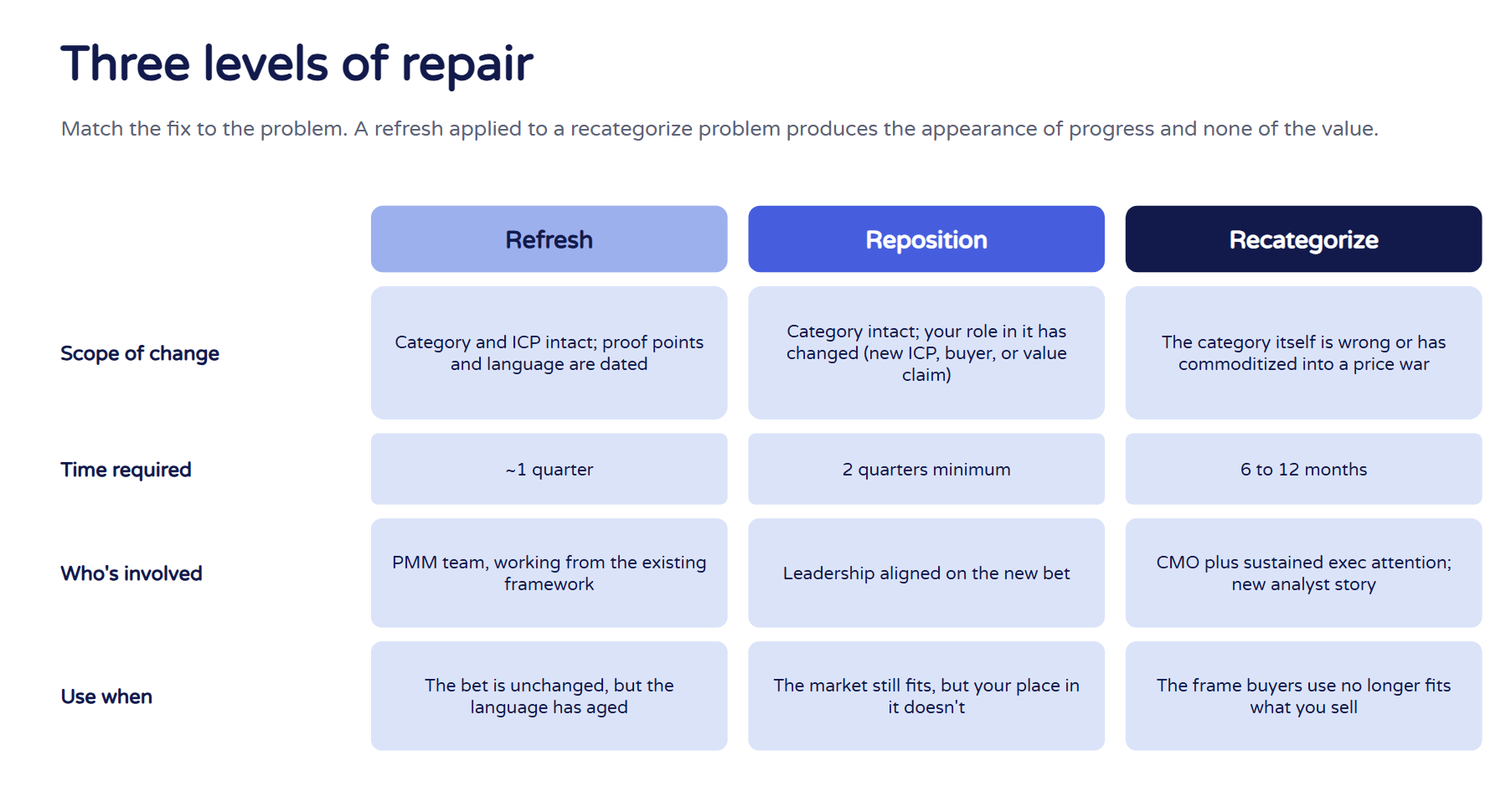
Once you have confirmed the positioning has expired, the next question is which level of repair to authorize. The three options are not interchangeable.
Refresh. The category and ICP are both intact, but the proof points have evolved, the language is dated, and the pillars need updating. Refresh is the lightest lift and the most common call, completed in a quarter using the existing framework as the starting point.
Reposition. The category is intact, but your role within it has changed. Maybe there’s a different ICP, different buyer, or different value claim. Reposition requires going back to the upstream commercialization decisions, takes two quarters at minimum, and is only worth attempting if leadership is aligned on the new bet.
Recategorize. The category itself is wrong. The frame buyers use no longer fits what you sell, or the category you helped build has commoditized to the point that staying in it is a price war. Recategorize is the most expensive option, but it also carries the highest upside. It requires a new analyst story, a new internal narrative, and a new sales motion with six to twelve months of executive attention.
The trap is reaching for the lightest fix when the underlying problem requires a heavier one. A refresh applied to a recategorize problem produces the appearance of progress and none of the value.
What this requires of CMOs
Positioning rarely fails in isolation. By the time it has expired, the function that owns it has typically been pushed downstream into launch support and sales enablement, where the symptoms first appear. The PMM team can flag the signals, but the call to act on them belongs upstream.
Across more than a hundred Fluvio engagements, the pattern repeats. Stale positioning shows up alongside ICP drift, messaging that no longer maps to the sales motion, and measurement that cannot see any of it. Each of those is a separate problem with a separate fix. Treating them as a positioning problem alone is how teams spend a quarter on a refresh and end up where they started.
Before authorizing the rewrite, run the diagnostic. The Fluvio GTM Assessment surfaces which signals are real, which pillars are exposed, and what level of repair the function actually needs.
That is the call only the CMO can make.