

The PMM Revenue Gap: Why Product Marketing Is Often Measured Too Late to Matter
Fluvio Research led by Lyle Burns
Executive Summary
Product marketing is increasingly expected to influence revenue outcomes. Yet in many organizations its impact remains difficult to measure and scale.
This report argues that the core challenge is often misunderstood.
Most organizations treat PMM's revenue impact as an attribution problem, a difficulty measuring how marketing activities contribute to pipeline or revenue. Our research suggests a different explanation: it is primarily an alignment problem.
When product marketing enters the commercialization process after key product and go-to-market decisions have already been made, the function is naturally pushed toward downstream execution such as launch support, messaging, and sales enablement. Commercialization refers to the decisions that determine how a product becomes a revenue opportunity, including market selection, product investment, positioning, and pricing. These decisions are typically shaped during the inbound product marketing motion.
When PMM enters only after these decisions are made, its role shifts toward the outbound motion of go-to-market execution, where teams focus on launch planning, messaging, and sales enablement. While these activities are important, they occur after many of the strategic decisions that determine revenue potential.
Organizations that see the strongest impact position product marketing earlier in the decision process. In these environments PMM helps translate market insight into product strategy, commercialization planning, and revenue execution.
Drawing on interviews with product marketing leaders, survey responses from PMM professionals, and practitioner insights from go‑to‑market advisory work, this report highlights four core insights.
Insight 1 — The PMM attribution problem is often an alignment problem
Organizations struggle to measure PMM's revenue impact when product marketing is brought into decisions too late to influence the outcomes that drive growth.
Insight 2 — Executive support does not always translate into decision authority
Leadership frequently views PMM as strategically important, yet organizational structures often limit its involvement in upstream decisions such as market selection, product investment, and commercialization strategy.
Insight 3 — PMM maturity is defined by decision influence
The most mature PMM organizations influence decisions earlier in the product lifecycle, shaping which opportunities are prioritized and how they are brought to market.
Insight 4 — High‑impact PMM teams operate commercialization systems
Leading organizations move beyond launch support and build repeatable commercialization systems that connect market insight, product strategy, and revenue execution.
Together these insights point to a shift in how organizations should think about product marketing. Rather than functioning primarily as a downstream marketing role, PMM becomes the commercialization engine that aligns product investment with market opportunity and revenue growth.
Research Approach
This report draws on three sources of insight:
Qualitative interviews with product marketing leaders responsible for go‑to‑market strategy, commercialization planning, and revenue enablement within their organizations.
Survey responses from product marketing professionals across B2B companies representing a range of organizational sizes and growth stages.
Practitioner perspective informed by advisory work supporting product marketing and go‑to‑market strategy across multiple industries.
While the dataset is intentionally directional rather than statistically representative, the combination of interviews, survey responses, and practitioner experience highlights consistent patterns in how product marketing organizations influence revenue outcomes.
The goal of this research is therefore not to produce definitive statistical conclusions, but to surface practical insights about how PMM teams operate and how organizations structure commercialization decisions.
Insight 1: The Attribution Problem Is Often an Alignment Problem
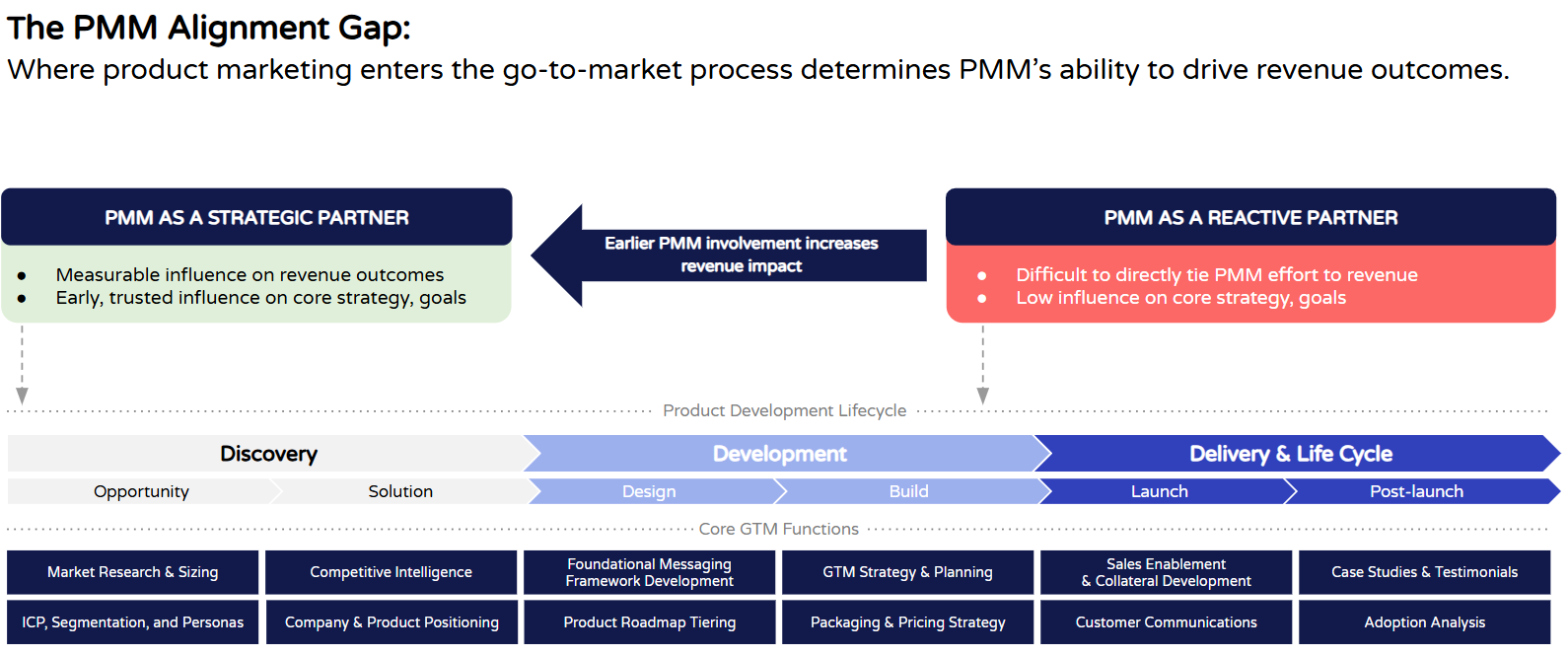
Many organizations struggle to connect product marketing activity to revenue outcomes.
In our survey, only a minority of respondents reported being very confident that product marketing directly influences revenue performance. A majority expressed only moderate confidence in PMM's measurable impact.
When asked about the source of this challenge, respondents most frequently pointed to attribution complexity and a lack of shared measurement frameworks.
“[PMM work] is not a causal relationship. It’s a correlation relationship. There are many things that correlate to a win and I can’t quantify what my contribution is among all the others.”
However, interviews with PMM leaders revealed a deeper pattern.
In many organizations product marketing enters the commercialization process after key strategic decisions have already been made, including roadmap, investment, and market priorities.
At that point product marketing’s role shifts to downstream execution, such as supporting launches, producing messaging, and enabling sales teams. These activities, while important, occur after the decisions that most directly influence revenue outcomes.
Product marketing leaders consistently emphasized that revenue impact begins much earlier in the commercialization process.
“[PMM ability to impact revenue] starts upstream. We’re forcing conversations from the beginning before they go and develop the product, because after that it’s a sunk cost. It’s too late.”
When PMM contributes to market segmentation, opportunity prioritization, and product investment decisions, the function helps shape where the company competes and how resources are allocated. These decisions ultimately determine the revenue potential of a product or initiative.
Organizations that involve PMM earlier in these strategic discussions report significantly greater confidence in product marketing's ability to influence revenue outcomes.
Insight 2: Executive Support Often Exists Without Decision Authority
A second pattern emerged from both the survey and interviews: 43% of product marketing leaders report strong executive alignment around the importance of PMM.
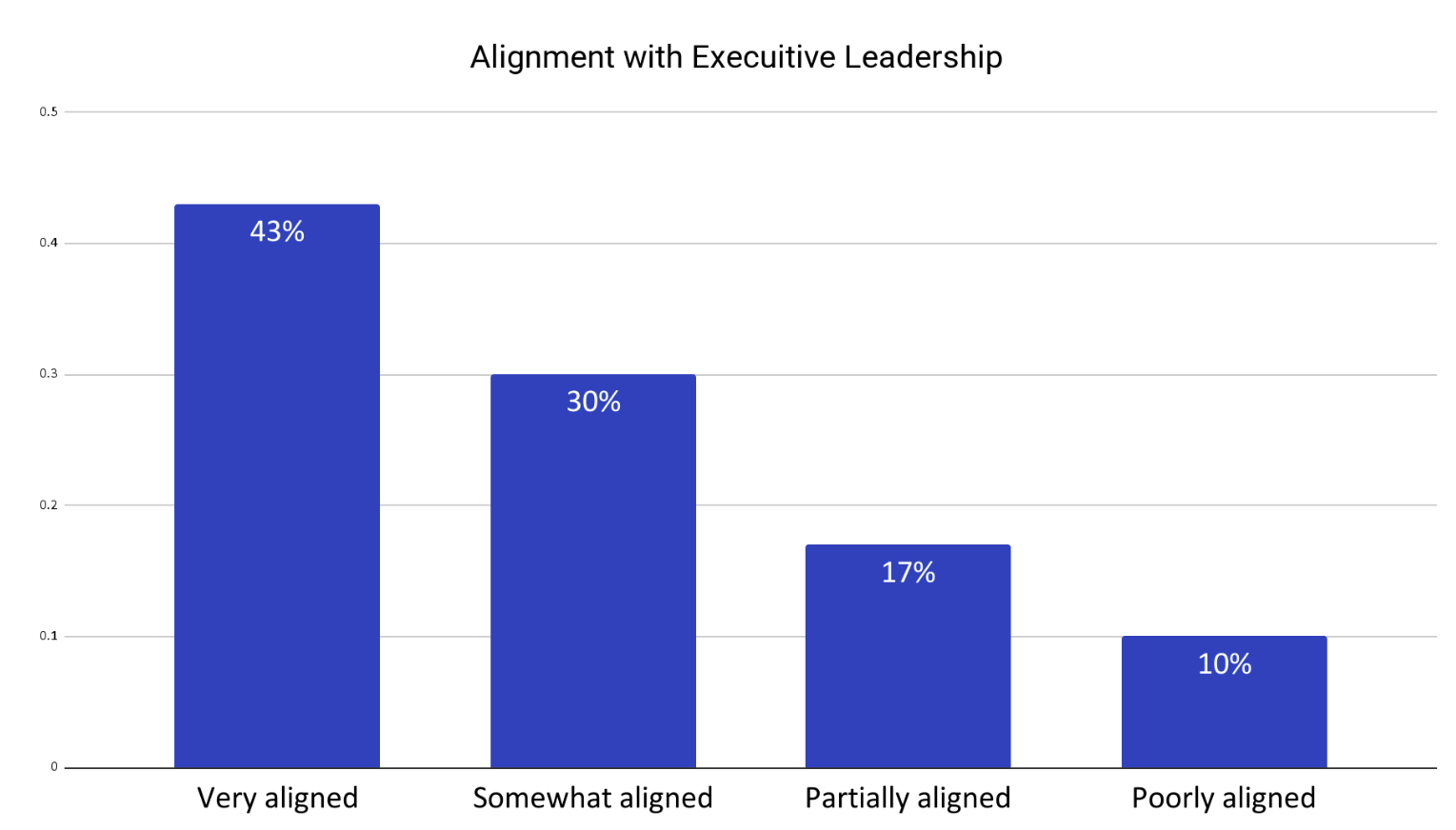
Respondents frequently described their teams as strategic partners to product, sales, and marketing leadership.
“[We’re seen as] an impactful thought leadership group. We’re a strategic partner for product, sales, partnerships, and field marketing. When done well you’re seen as a strategic partner.”
However, this alignment in principle does not always translate into structural influence.
Only 10% of respondents reported having consistent executive sponsorship that brings product marketing into early-stage strategic decisions. In many organizations PMM participates in discussions about go-to-market execution but is less consistently involved in conversations about market prioritization or product investment.
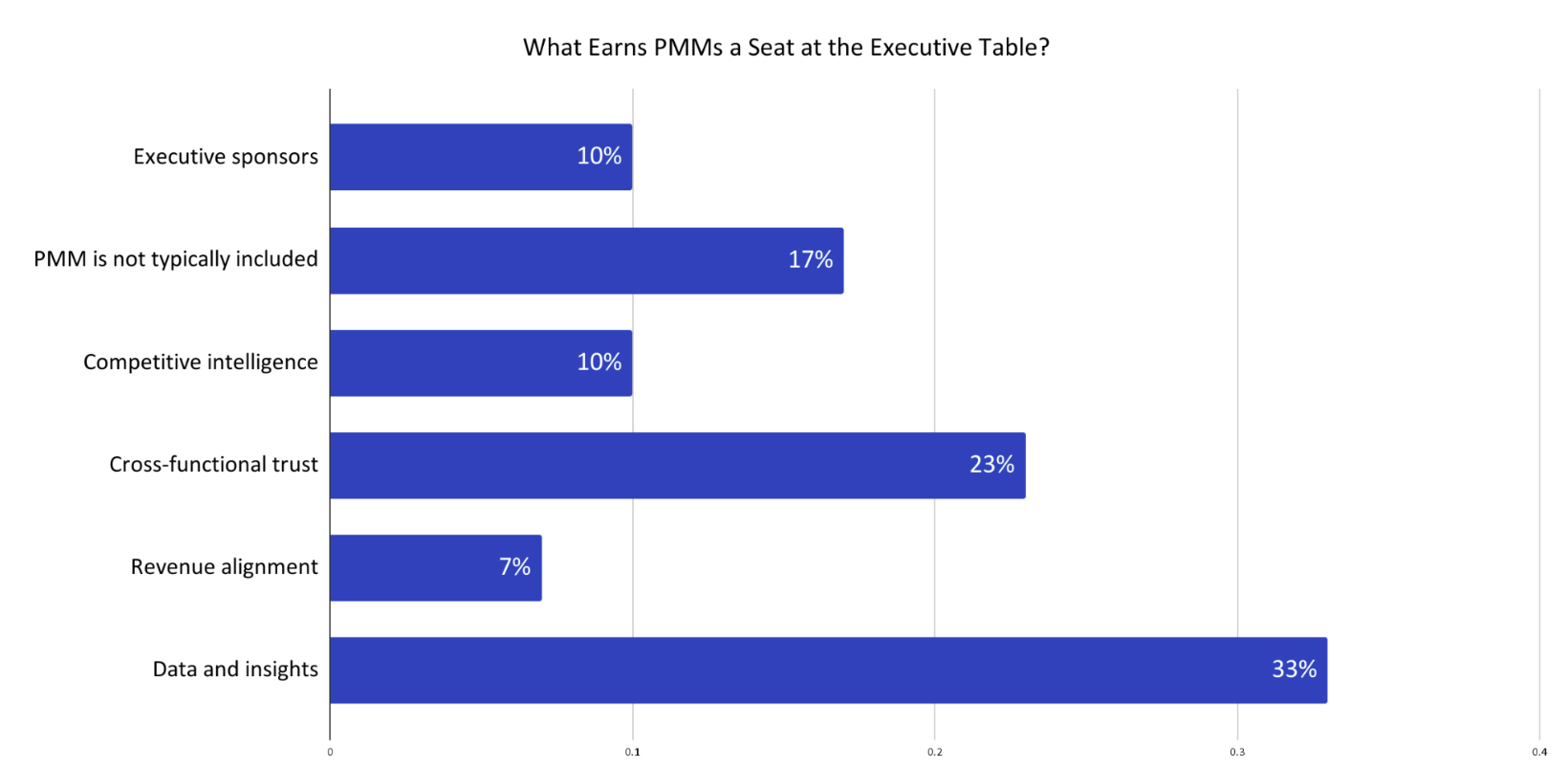
“I think they view us as an enablement function… not the strategic function as much as we are or as much as we could be.”
This creates a form of alignment without authority.
Leadership often recognizes PMM’s strategic importance, but this alignment does not consistently translate into early-stage decision involvement.
As a result PMM's influence tends to be indirect and difficult to measure.
Organizations seeking greater revenue impact from product marketing must therefore address both measurement challenges and the organizational structures that determine when PMM participates in strategic decisions.
Insight 3: PMM Maturity Is Defined by Decision Influence
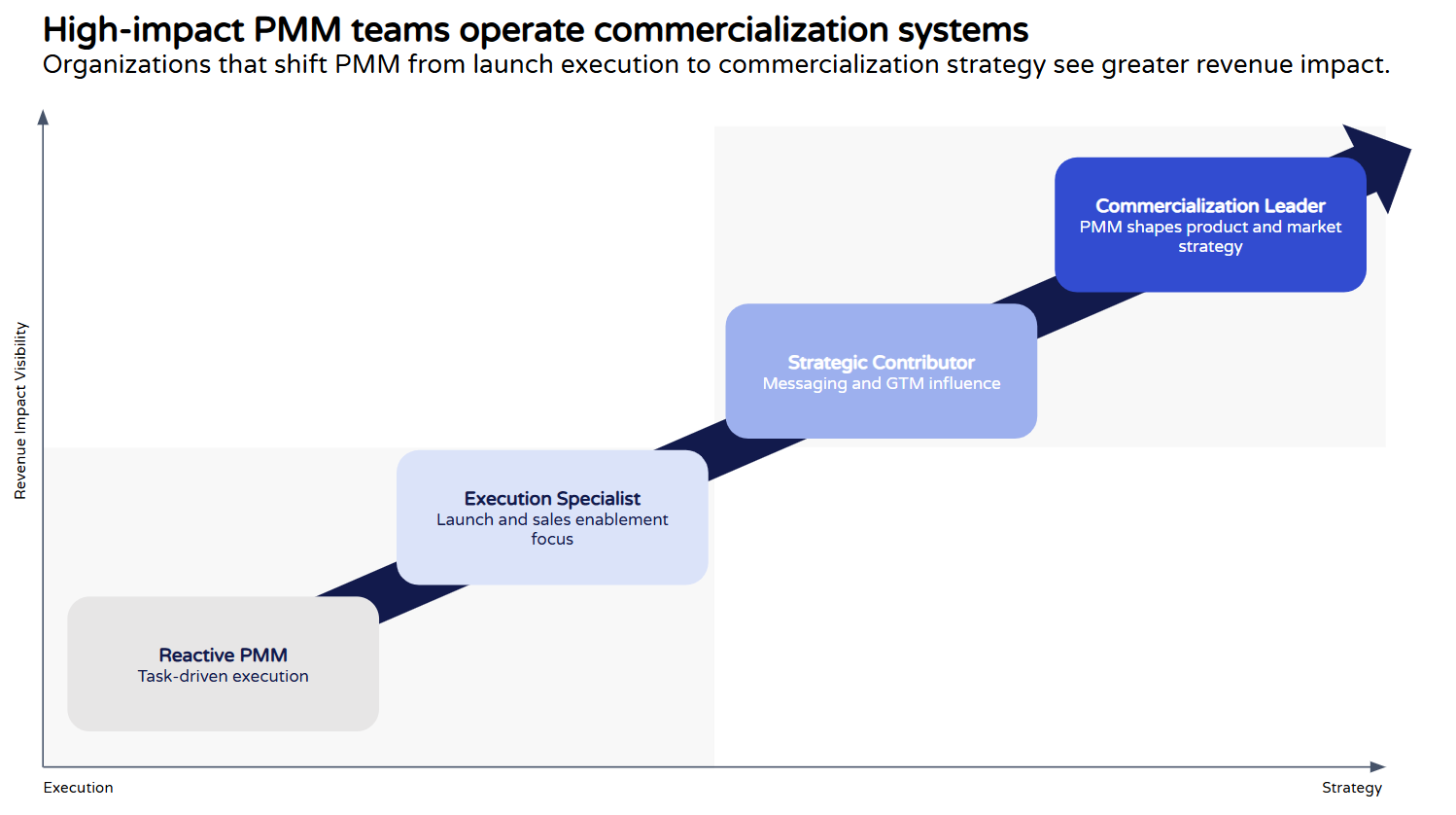
Differences in how organizations position product marketing create clear differences in PMM maturity.
In less mature environments PMM work is driven primarily by launches, enablement needs, and internal requests. Product marketing supports execution after product and go-to-market decisions have already been made. This is reflected in how organizations perceive the function. Only 7% of respondents describe PMM as a strategic revenue driver, while many view the role primarily as an execution partner or support function.
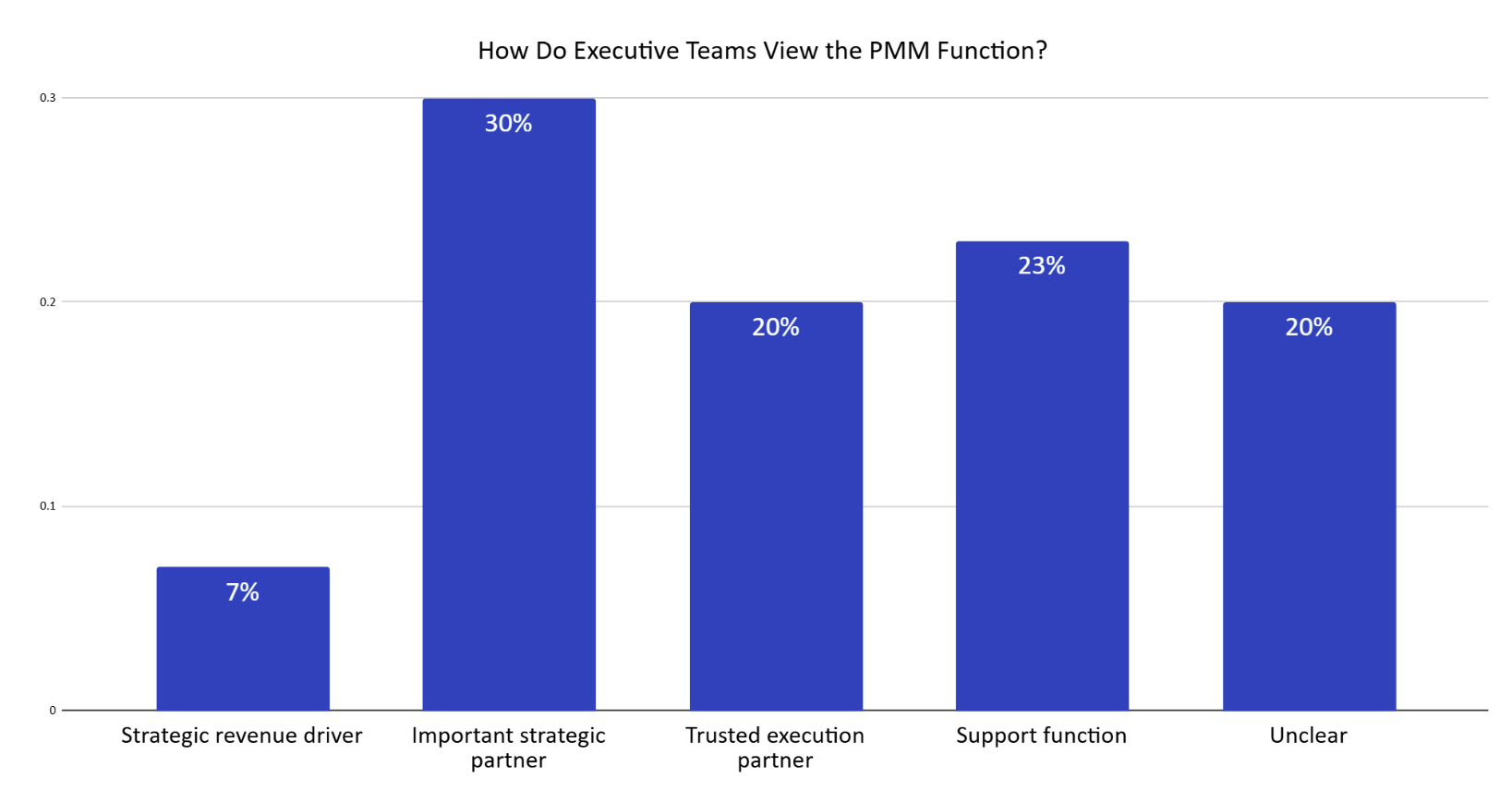
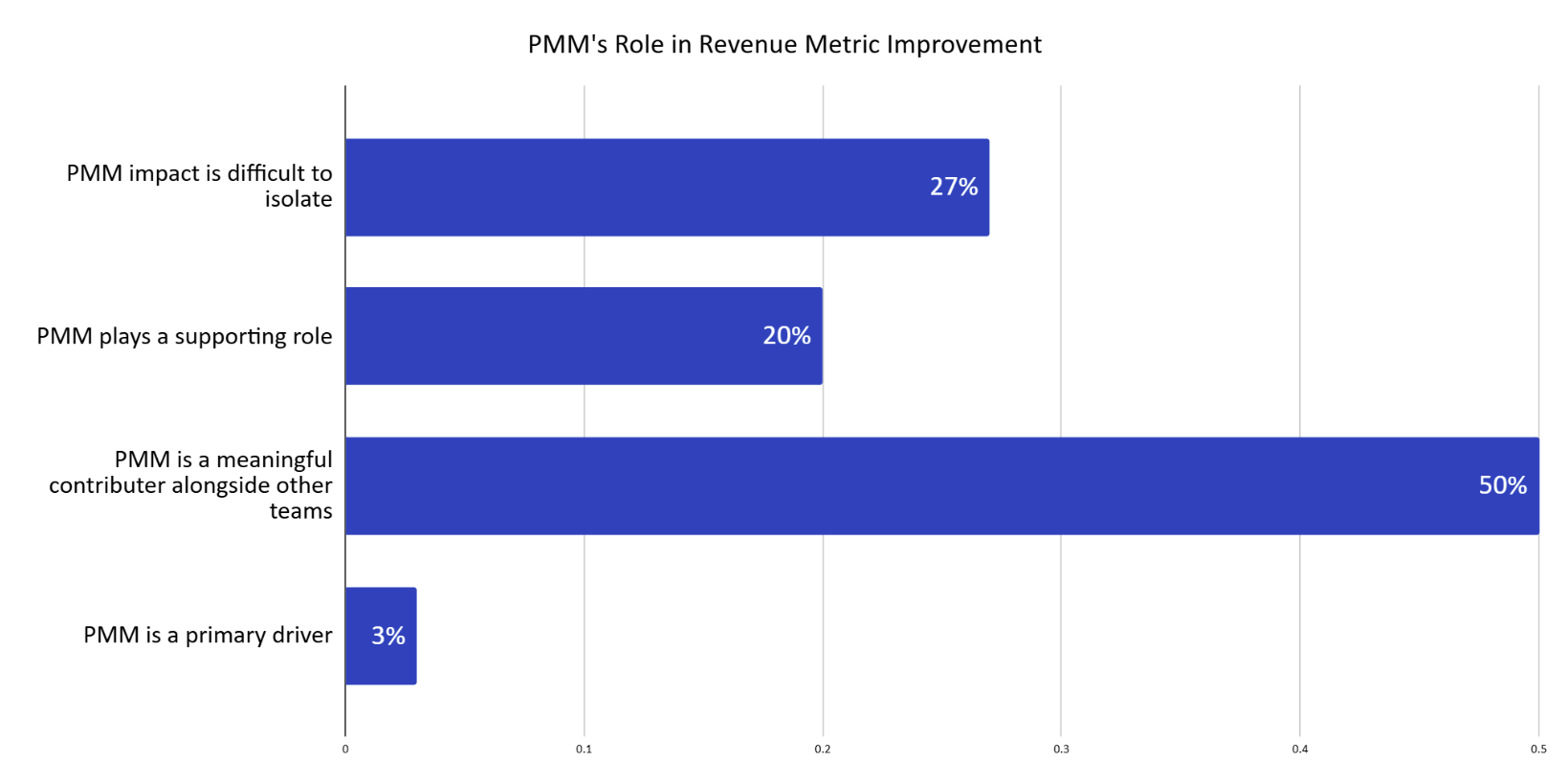
In these environments product marketing contributes to revenue outcomes but rarely leads the decisions that shape them, with only 3% of respondents identifying PMM as a primary driver of revenue improvement. This reflects a model where PMM supports go-to-market execution but is not positioned to influence the upstream decisions that determine how products will generate revenue.
In more mature organizations product marketing enters the process earlier. Rather than focusing primarily on launch execution, PMM helps identify attractive market segments, shape product positioning, and prioritize opportunities with the greatest revenue potential. By contributing customer and market insight before major investments are committed, product marketing helps guide commercialization decisions that ultimately determine revenue outcomes.
The defining difference between these environments is not company size or team structure but where PMM influences decisions.
Interviews with PMM leaders also highlighted the role of prioritization in determining this maturity. Many teams support large product portfolios with relatively small PMM organizations.
“Our ratio right now is almost eleven product managers to one product marketer.”
“We need ruthless prioritization at the executive level… everyone wants to do everything.”
Without clear prioritization frameworks, teams are easily pulled into reactive work.
More mature organizations address this challenge by aligning PMM capacity directly with the initiatives most likely to drive growth.
This shift in prioritization gradually moves product marketing upstream, from execution support toward commercialization strategy.
“Being really clear about what I’m not able to deliver has actually led directly to the expansion of the team.”
Insight 4: High‑Impact PMM Teams Operate Commercialization Systems
A consistent theme that appeared in interviews is that the most effective PMM organizations share another characteristic: they operate within structured commercialization systems.
High-impact organizations move beyond isolated launches and build repeatable systems that connect market insight, product decisions, and go-to-market execution.
This commercialization process typically includes several core components:
1. Market intelligence
Continuous research into customer needs, market dynamics, and competitive positioning.
2. Opportunity prioritization
Structured evaluation of which segments, products, and initiatives represent the greatest revenue potential.
3. Commercialization strategy
Translation of product investments into clear positioning, pricing, and go‑to‑market strategies.
4. Revenue execution
Coordination across product, marketing, and sales teams to bring opportunities to market effectively.
When these elements operate together, product marketing becomes the connective layer that aligns product strategy with revenue outcomes.
Building Go-to-Market Infrastructure
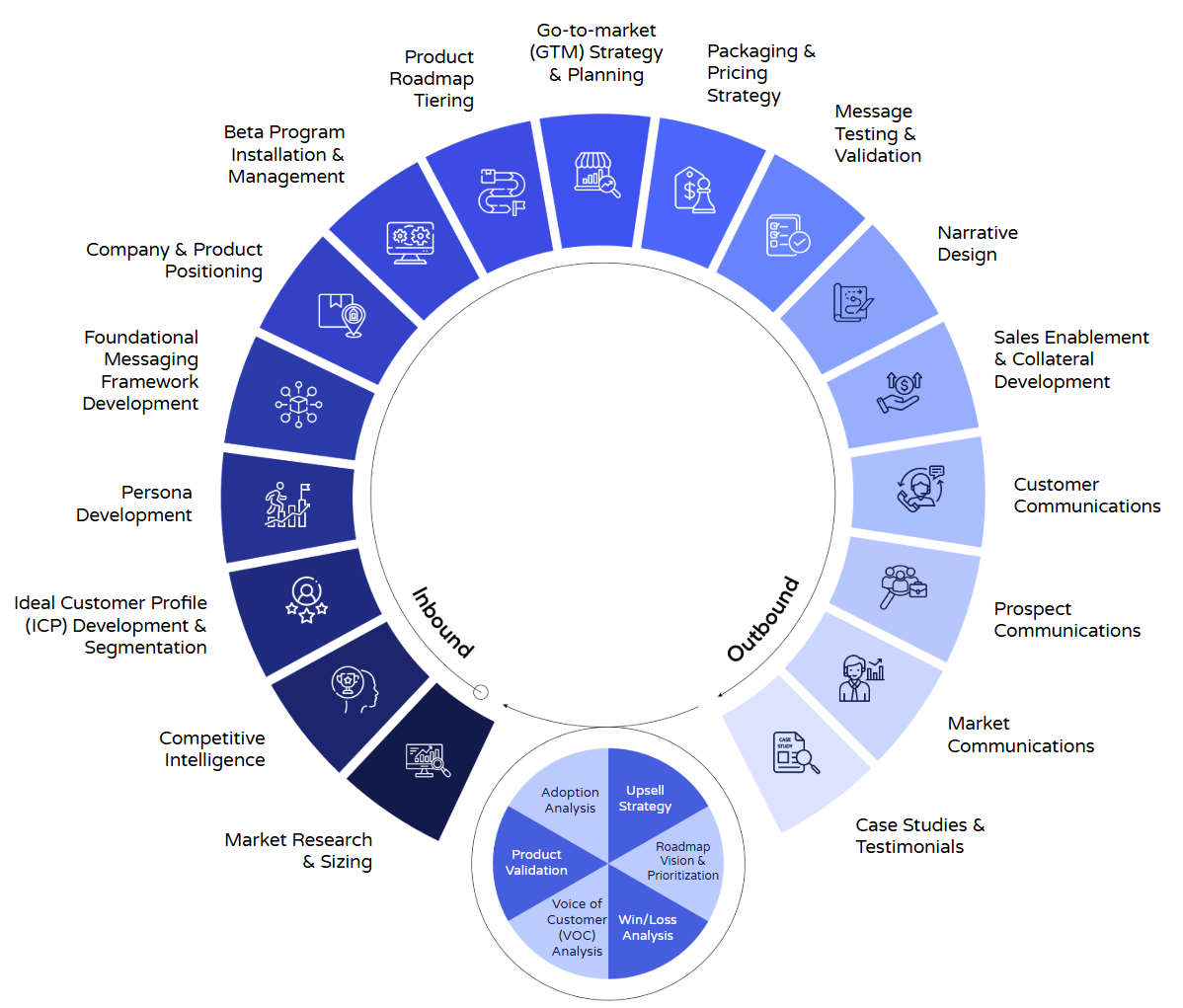
Through our work supporting product marketing and go-to-market strategy, we observe that high-performing organizations build GTM infrastructure that connects inbound commercialization decisions with outbound execution.
This system integrates two critical flows of information:
Inbound insight: market research, competitive intelligence, customer feedback, segmentation, and positioning
Outbound execution: go-to-market strategy and planning, pricing and packaging, sales enablement, and market communication
When these flows are integrated, organizations are able to translate product investments into consistent revenue outcomes.
Product marketing sits at the center of this system because it connects market understanding with commercialization decisions.
The Operating Model Shift: From Launch Support to Commercialization Leadership
One of the clearest patterns that emerged from the research is that the impact of product marketing is shaped less by what PMM teams do and more by when they enter the decision process.
In many organizations, product marketing is engaged primarily during launch preparation or go-to-market execution. In these environments PMM is primarily focused on launch execution, sales enablement, and supporting go-to-market programs rather than shaping how the product will generate revenue. As a result, the impact of product marketing is often measured through downstream go-to-market metrics that PMM influences but does not directly own. Survey respondents reported that PMM most strongly influences metrics such as pipeline creation and lead generation (80%), highlighting how the function’s impact is tied to activities that occur later in the go-to-market process.
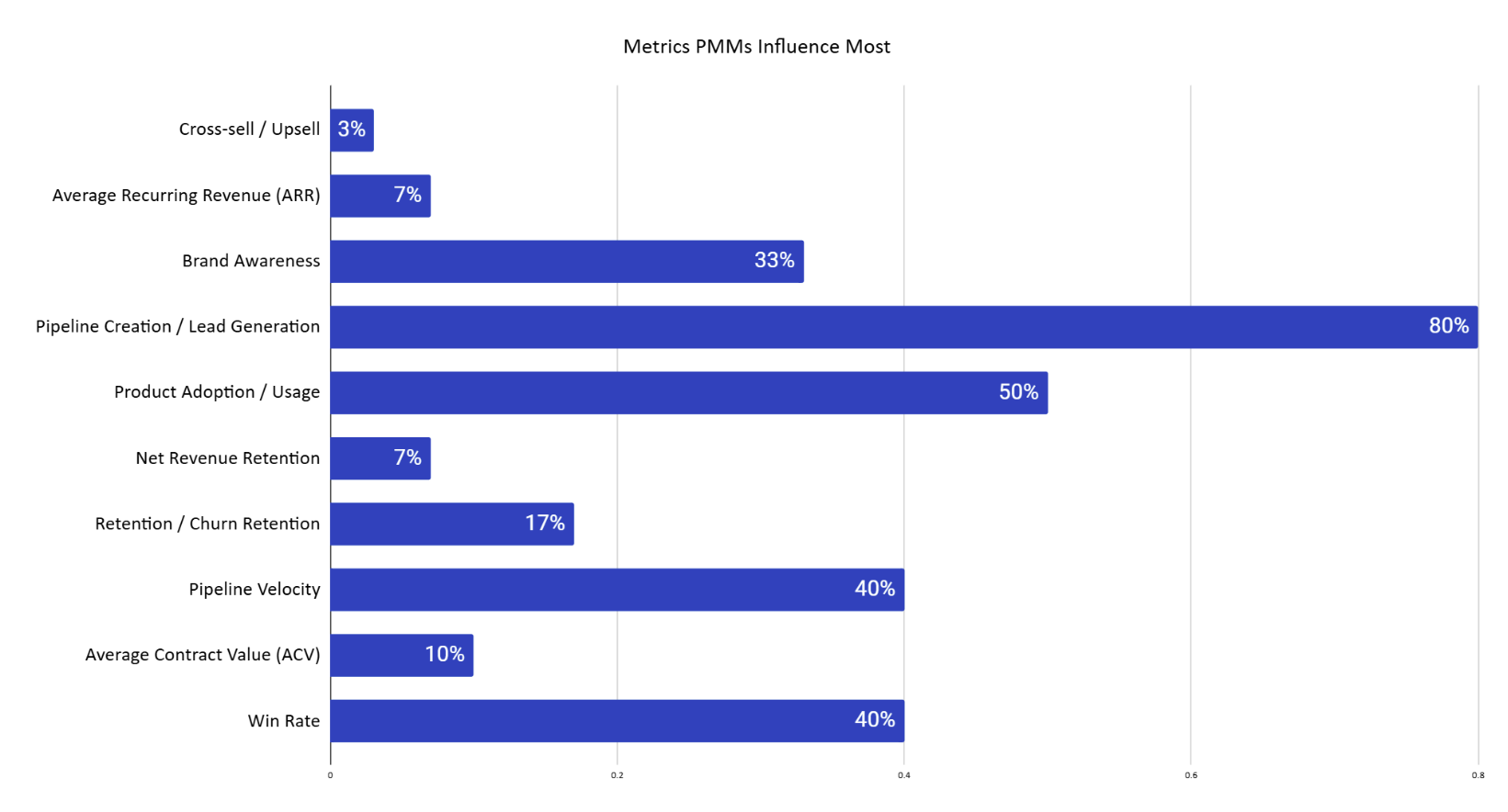
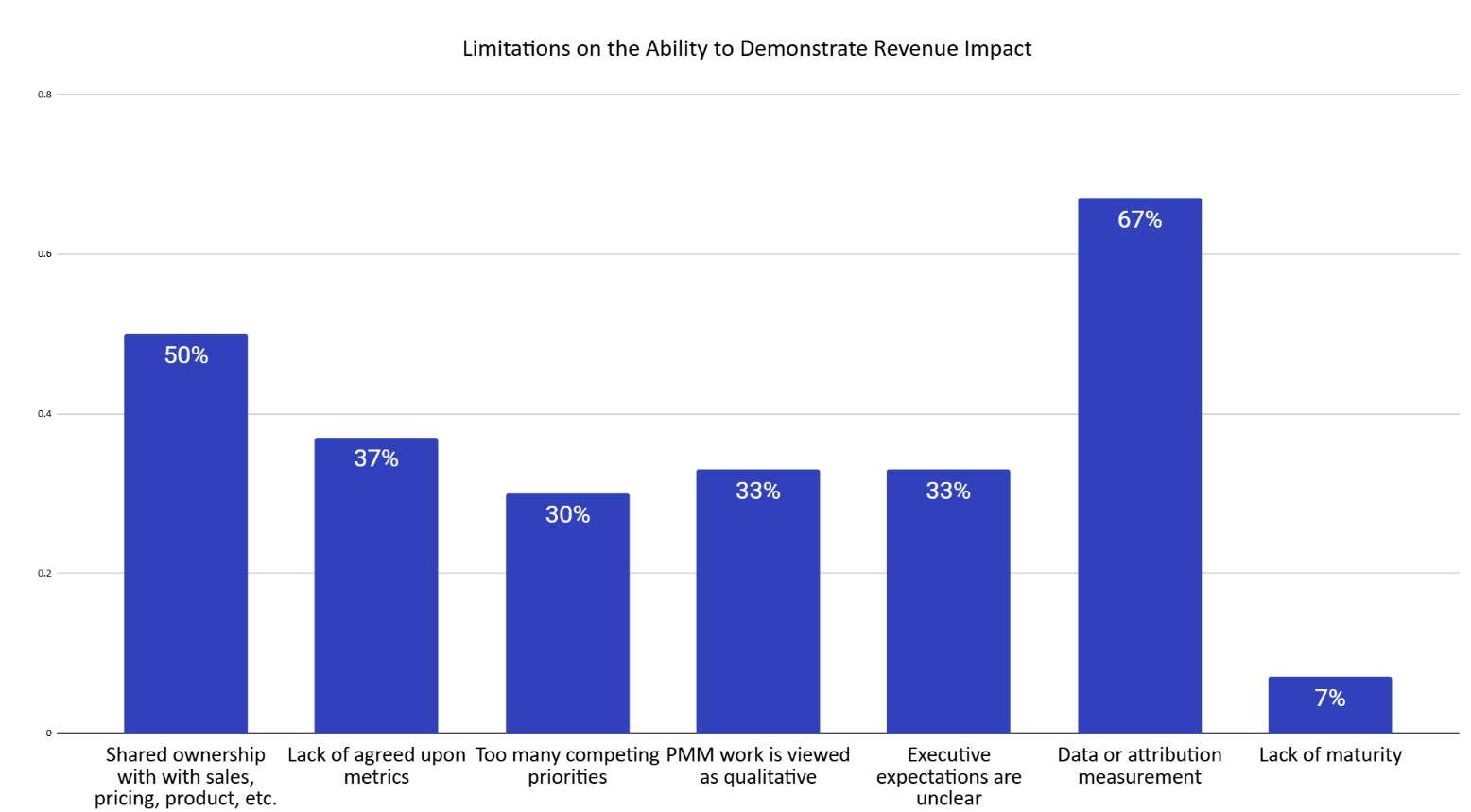
This dynamic also helps explain why many organizations struggle to clearly attribute revenue impact to product marketing. 67% of respondents cited data or attribution limitations as a major barrier to demonstrating PMM’s contribution to revenue outcomes. When PMM enters the process late, its influence is distributed across multiple downstream activities, making it difficult to isolate the role product marketing played in shaping the final outcome.
In higher-maturity organizations, product marketing enters the process earlier. Rather than focusing primarily on launch execution, PMM helps evaluate market opportunities, shape product positioning, and guide commercialization strategy before significant investments are committed. By contributing customer and market insight at this stage, product marketing helps define how a product will compete in the market and how it will ultimately generate revenue.
This shift fundamentally changes the operating model of product marketing.
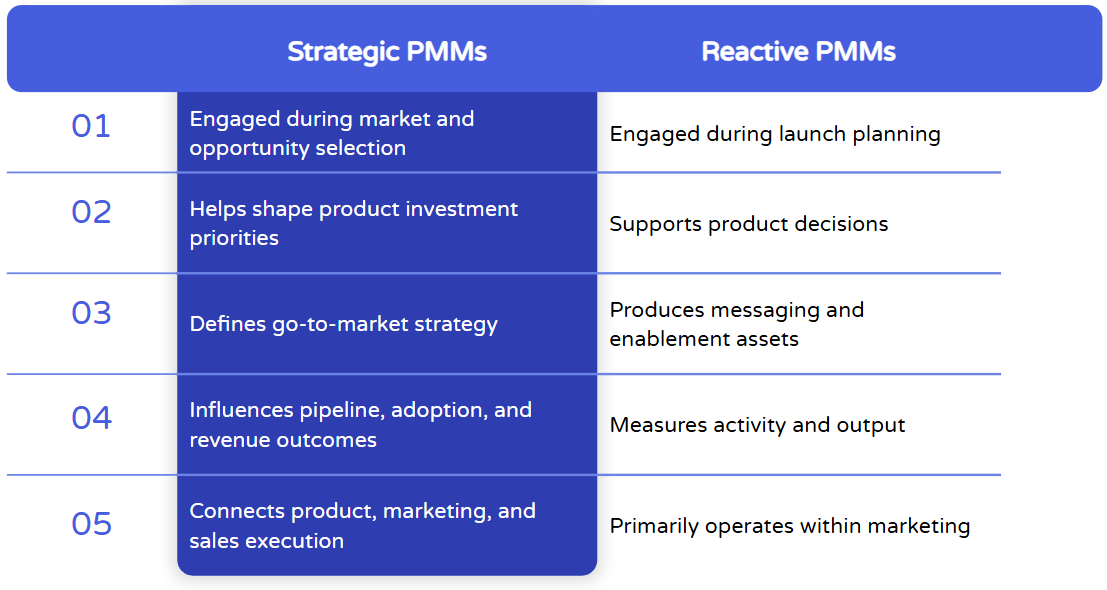
The transition from reactive to strategic PMM therefore does not simply involve expanding responsibilities. Instead it requires repositioning product marketing earlier in the commercialization decision chain.
When PMM participates in market insight, opportunity prioritization, and commercialization strategy, the function becomes capable of influencing the decisions that determine revenue outcomes.
How Organizations Can Unlock Strategic PMM Impact
The research in this report suggests several practical steps organizations can take to increase the strategic impact of product marketing.
1. Anchor PMM in Market and Customer Insight
Product marketing earns strategic influence when it provides unique insight into customer needs, competitive dynamics, and emerging opportunities.
Organizations that empower PMM to own this perspective create stronger foundations for product and go‑to‑market decisions.
2. Connect Product Decisions to Commercial Opportunity
PMM can help leadership teams evaluate product investments through a commercial lens, considering market size, segment attractiveness, and competitive differentiation.
This perspective ensures that product strategy aligns with the opportunities most likely to drive revenue growth.
3. Focus PMM Capacity on High‑Impact Opportunities
Without clear prioritization frameworks, PMM teams often become spread across too many initiatives.
Aligning PMM capacity with the company's growth priorities allows the function to focus on initiatives with the greatest potential impact.
4. Measure PMM Through Business Outcomes
Organizations seeking to elevate product marketing should measure the function through metrics that reflect commercial outcomes, such as pipeline contribution, win rates, product adoption, and expansion revenue.
These indicators provide a clearer connection between PMM activity and revenue performance.
Conclusion: Product Marketing as the Engine Connecting Commercialization and Go-to-Market
Product marketing creates the greatest value when it helps shape commercialization decisions and connects inbound insight to outbound go-to-market execution through strong GTM infrastructure.
In these environments product marketing helps organizations answer critical growth questions:
Where should we compete?
Which customer segments represent the greatest opportunity?
How should product investments translate into revenue growth?
What go‑to‑market strategy will drive adoption and expansion?
As markets become more competitive and product innovation accelerates, the ability to consistently translate product investments into revenue outcomes becomes increasingly important.
Organizations that position product marketing as the commercialization engine, rather than a downstream marketing function, are better equipped to align teams, prioritize opportunities, and turn market insight into sustained growth.