

2026 Product Marketing Hiring Trends Report: AI Is Hiding What's Still Broken
Fluvio Research led by Daniel THai
Executive Summary
Companies hiring product leaders are operating in one of the deepest qualified candidate pools in recent memory. With more candidates competing for fewer open roles, hiring teams face less urgency and more optionality than in years past. On the surface, this should make PMM hiring easier. Instead, the depth of the market has masked persistent organizational issues that continue to undermine hiring outcomes.
For the second consecutive year, Fluvio surveyed experienced PMM candidates (85% of respondents had 6 or more years of experience) to understand what is actually happening in PMM hiring today. The 2026 findings show a consistent pattern: underlying conditions continue to be broken in a way that hampers matching the best candidates to the best roles. AI is beginning to drive more efficiencies in the process, but it is also expanding the expected scopes. The 2025 report identified role definition, organizational readiness, and cross-functional alignment as the root causes of PMM hiring failure; in 2026, none of those conditions have meaningfully improved.
A key driver of this disconnect is the gap between how roles are articulated and how they are actually defined inside organizations. As AI accelerates how roles are described and publicized, job descriptions can appear increasingly standardized even when internal alignment on scope, expectations, and success criteria is incomplete. In practice, this makes roles look clearer than they are while often lacking the underlying definition work required to support them.
Misalignment persists after the hire. Among PMMs who accepted offers, 87% described their resource and support environment as inadequate or only somewhat adequate, while only 33% reported clear cross-functional alignment upon arrival. Without stronger organizational alignment, these issues will continue to limit the effectiveness of product marketing leadership.
The State of PMM Hiring
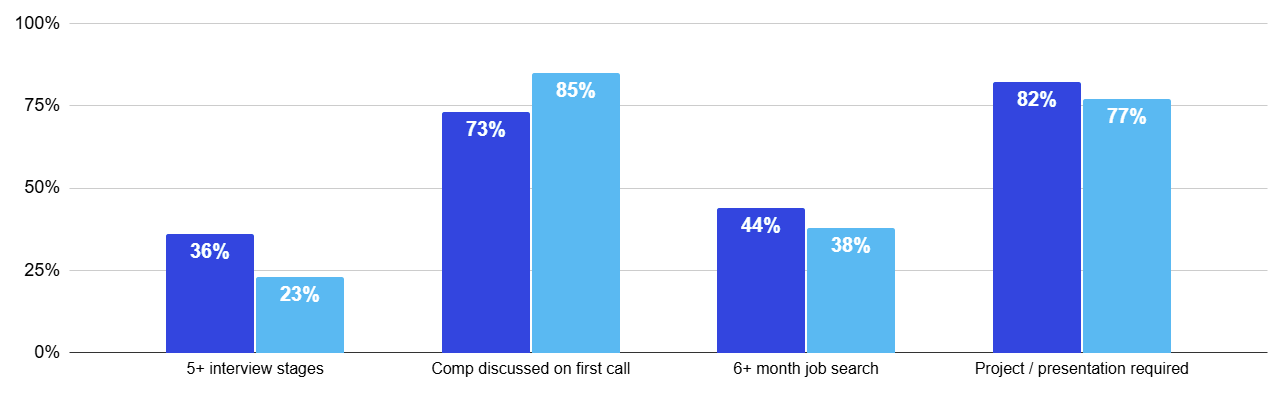
On the surface, the product marketing hiring market in 2026 presents a surface picture of improvement. While interview processes are still long and time-consuming, candidates are moving through hiring more quickly, extended hiring cycles are less common, and compensation is being surfaced earlier.
On process measures, organizations are getting marginally more efficient. The proportion of candidates going through five or more interview stages fell from 36% to 23% year-over-year, and 85% reported that compensation was discussed on the first call, up from 73% in 2025.
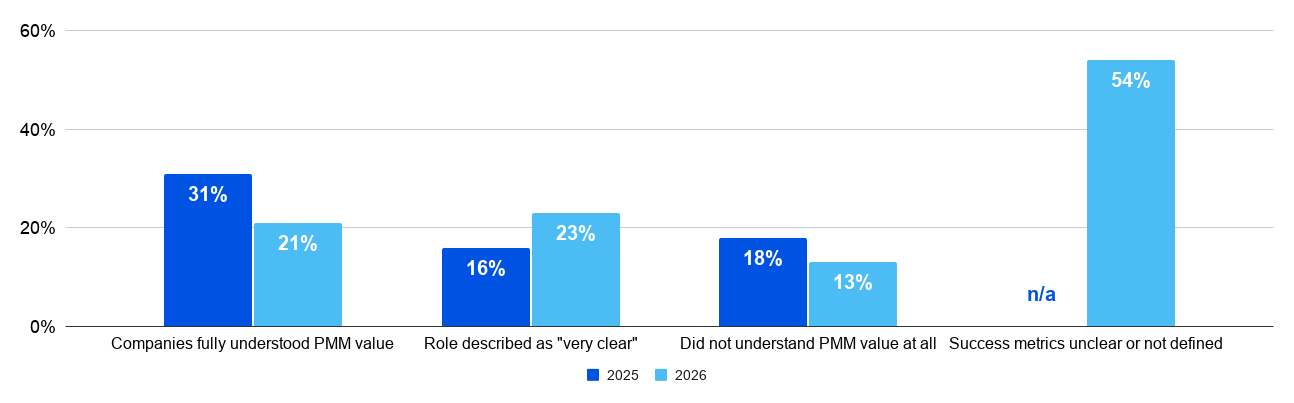
The organizational conditions required to make a hire succeed have not kept pace. Fewer organizations understood what they were hiring for than in 2025, and success metrics remained undefined across the board. Across role clarity, value understanding, and post-hire alignment, the dominant response in 2026 is “somewhat,” signaling that organizations know enough to open a search, but not enough to set one up for success.
“Companies are certainly waffling about how they want to go about hiring. I’ve seen a lot of reqs open up, interviewed for some, and then they pull the req. People are working through how AI is going to impact workforces.”
Findings and Analysis
The Role Definition Problem Has Not Been Solved
In 2026, zero survey respondents described the success metrics for their target role as "very clear," a finding that holds across company sizes and seniority levels alike. Roles have grown more detailed as lists of responsibilities, but candidates described meaningful role definition as something different: clear ownership areas, named stakeholders, and success criteria framed as outcomes for the first 30, 60, and 90 days.
“Job descriptions providing detail on what success looks like at 30, 60, or 90 days are a green light indicator of a more mature thought process. The core question is whether the narrower focus is a time-constrained solution or if they will be doing the same tasks 18 months later.”
That specificity signals not just what the role is, but that the organization knows how to use product marketing. When candidates asked hiring managers directly what success looked like, most defaulted to outputs — timely launches, content volume — rather than business outcomes.
“I would look at it and say product marketing can have a revenue impact. We can absolutely [be a catalyst] in helping organizations reach certain goals or improve retention rates, improve product adoption. And most companies right now that I’m talking to, large and small, aren’t thinking that way.”
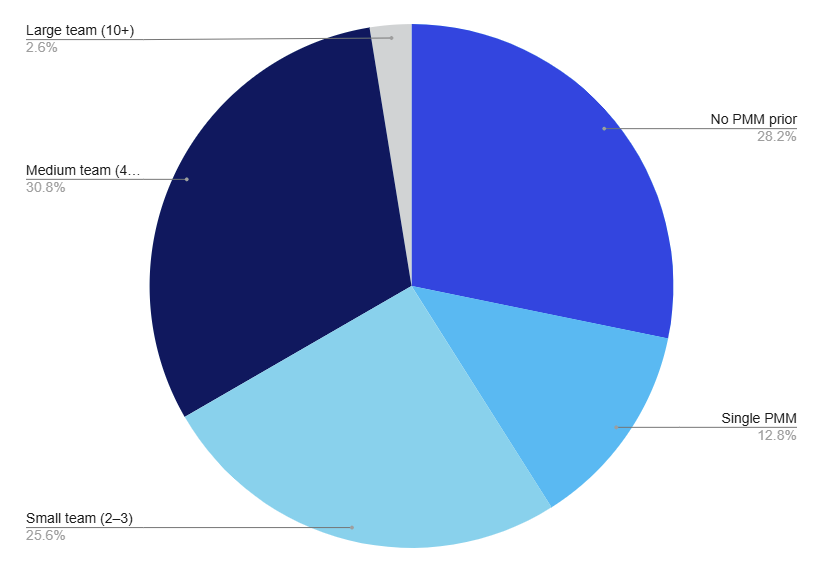
Roughly four in ten 2026 searches took place in organizations with either no prior product marketing function or a single PMM. They knew PMM was the answer. They struggled to articulate what that would actually require: what the role would own, how it would be empowered, and what success would look like once someone was in the seat.
“Even the recruiter said at one point, ‘I don’t think they know what they want.’ I saw the red flags. But it was so hard in the job market that my belief was always that once I’m working, they’ll see the great work that I’m doing.”
Organizational Maturity Remains the Deciding Variable
When organizational alignment isn't in place before a PMM arrives, the hire is unlikely to succeed regardless of who fills the role. Of candidates who accepted offers:
Only 17% said they were set up with the resources and support needed to succeed.
41% said the scope wasn't realistic for one person.
33% of hired PMMs said clear ownership and alignment across functions was in place when they arrived.
Therefore, the resource most consistently absent was not headcount but cross-functional alignment.
“Anytime there’s a misalignment of anything in the hiring process, it immediately puts a bad taste in your mouth. Short term, you’re risking somebody just saying, ‘Hey, this isn’t what I signed up for’ and leaving, which puts both parties at square zero.”
While two thirds of respondents were expected to own sales readiness, Sales was involved in only 38% of interview processes. The function a PMM is most expected to serve rarely meets the candidate before they join, which can be a signal that the organization hasn't done the internal alignment work required to support the hire.
“Product marketing, if done well, builds a bridge between those two groups. But veteran sales teams getting new ways of being enabled and trained feel challenged to prove they can do it. That can cause friction.”
Every instance of significant post-hire misalignment in the 2026 data came from net-new roles. Backfills all had at least some alignment: the organization had prior experience of what product marketing should produce, and expectations on both sides were anchored to something real.
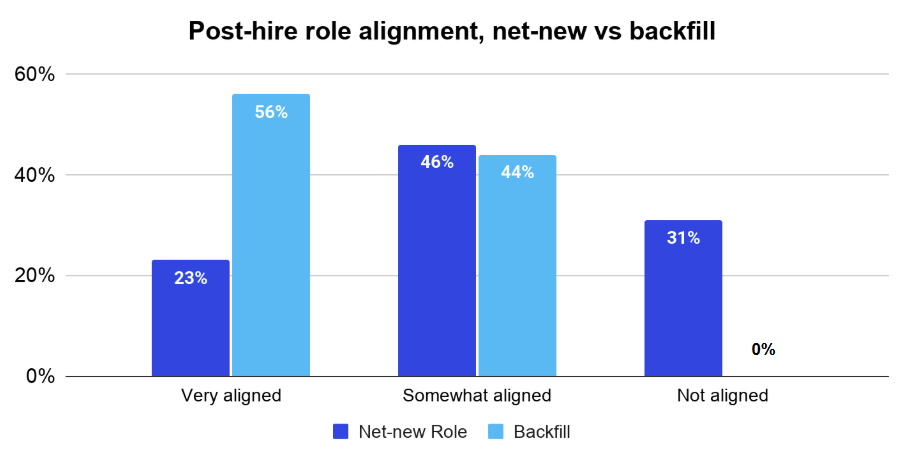
Net-new roles carry structurally higher misalignment risk because no such reference point exists. When PMM is expected to own the GTM motion without the cross-functional authority to drive it, the role becomes one where a single person is accountable for outcomes they can't fully control.
“Coming in as a new product marketer can be challenging. If they’re already controlling customer marketing, you don’t find yourself really having a role. You’re invited to the meetings, but they’re doing all the meaningful, impactful work.”
AI Is Expanding the Problem, Not Solving It
Fluvio's 2025 Product Marketing AI Trends Report found that 88% of PMMs expect their use of AI to increase. That shift is now shaping the PMM hiring market in two distinct ways: how organizations find and evaluate candidates, and what they expect of them once hired.
In the hiring process, candidates described an increasingly challenging environment shaped by AI-assisted screening and AI-generated job postings. AI is also affecting how roles are defined before a search begins.
Candidates described job postings that appeared detailed but generic. The job descriptions usually covered all of the broad product marketing responsibilities rather than reflecting the specific context or priorities of the organization posting them. The specific priorities usually revealed themselves during the interview process.
“You can just tell that 95% of [job descriptions] were written by AI. You have no idea what this function is. You really don’t understand product marketing. You probably had a recruiter have AI come up with something.”
“A lot of job descriptions are very generic. They just talk about handling go-to-market, creating sales assets, doing webinars, talking about the roadmap. People are looking for more than that.”
Many suspected automated filters were applying broad, generalized criteria rather than evaluating the judgment-based qualities that make someone specifically effective in product marketing.
Concurrently, AI has made it easier for candidates to generate applications and tailor resumes at scale, expanding the applicant pool and making individual applications harder to distinguish. Multiple candidates described adapting their materials specifically to clear automated filters. Over time, the hiring process will be dominated by AI-generated applications being screened by AI filters, turning intended efficiency into busy noise.
Inside the role, 82% of respondents said they were expected to use AI tools, with 72% saying AI increased the expected output or scope.
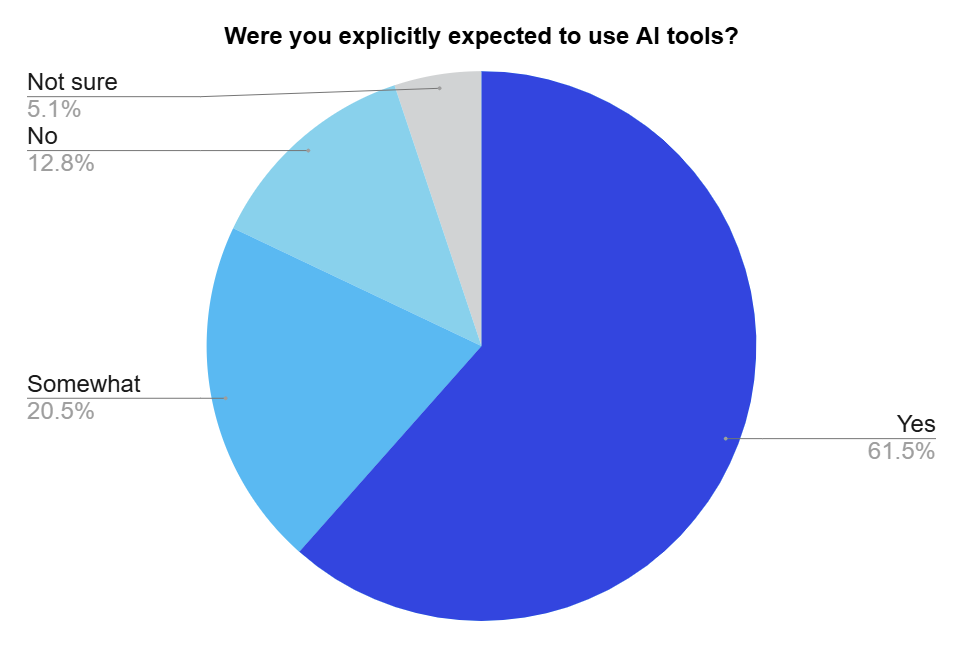
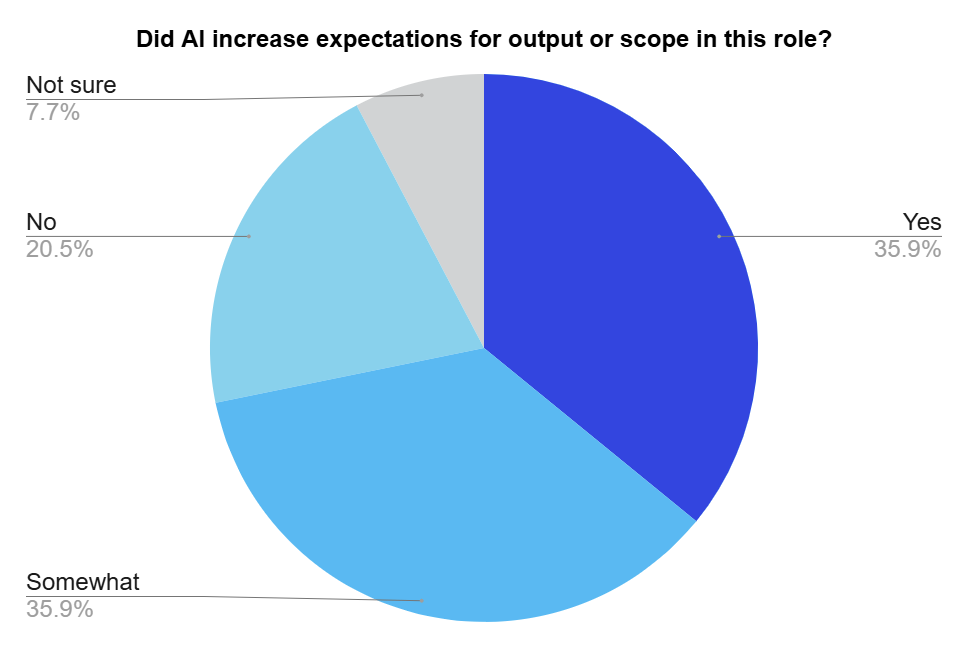
This likely translates into reduced headcount or expanded mandates rather than more space for strategic work. The PMM absorbs the expanded scope, makes strategic calls with less time and support, and owns the accountability when results don't follow.
“The size of the team is definitely getting smaller because there’s the overall assumption that ‘I’ll give you AI, and you’ll be able to do more.’ AI’s not there yet, but they will downsize the teams now and see what happens.”
Product marketing has traditionally been described as a T-shaped discipline: broad enough to connect across functions like product, sales, and marketing, with meaningful depth in a core area like positioning, competitive intelligence, or go-to-market strategy. AI is widening the top of that T while compressing the stem.
“PMMs do two to three times the work they used to be able to do with AI. But there’s a big tension around: are you using AI to increase the breadth of what you do, or are you using AI to increase the quality? You could have one PMM spend twenty hours and re-message eight products. Are they going to be good? Probably not.”
PMMs are being asked to cover more surface area instead of spending more time working strategically, such as developing a comprehensive view of the market, building real relationships with customers, or pressure-testing messaging. When a PMM is measured by output volume, the organization is actually searching for execution speed over strategic judgment — the exact opposite of what most organizations say they want from a senior PMM.
“It’s very rare to see a job description that shows this is how you’re going to be leading the organization through this. It wasn’t just ‘you’re going to help us with branding and messaging.’ It was ‘you’re going to be playing this critical role in helping accelerate revenue.’ That was very rare.
”
Senior Candidates Are Carrying the Most Risk
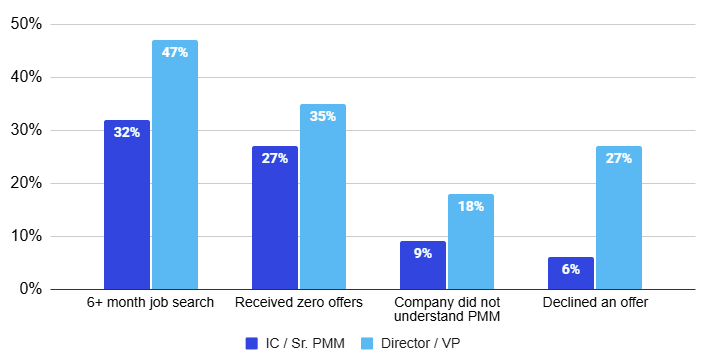
The 2025 report found that Director and VP candidates experienced more friction than IC counterparts at every stage. In 2026, that gap has widened. Long searches are not uncommon at any level, but the burden is disproportionately concentrated at the top.
Nearly half of Director and VP candidates searched for six months or longer — up from 35% in 2025 — compared to roughly one in three IC and Senior PMM candidates. The zero-offer rate follows the same pattern: 35% of Director and VP candidates received no offers despite an active search, compared to 27% of IC and Senior PMM candidates.
Leadership roles in 2026 frequently carried the role-design problems of founding product marketing positions: broad mandates, undefined ownership, and expectations of building function strategy without the cross-functional authority or infrastructure to influence broader business outcomes. Senior candidates with the experience to recognize those conditions are more likely to disengage or decline an offer (27%), but candidates with fewer options may be resigned to take those roles despite the issues.
“I will actually tease that out during the interview when I talk to the hiring manager. What would success look like? What kind of metrics would you use? And often they don’t have a good answer. They just say, as long as things are being launched on time.”
Compensation is where that misalignment becomes most tangible. Among the respondents who declined at least one offer, compensation misalignment was the most commonly cited reason, named by 57%. Director-level roles were often banded at senior IC compensation levels, which signals, intentionally or not, that the organization undervalues what PMM leadership actually requires.
“Seeing low-to-mid six-figure salaries for Director-level roles suggests the company is only valuing the PMM for content creation. They’re sending the wrong signals and hiring the wrong candidates, and creating a lot of friction for the right ones.”
The organizational cost of losing these candidates is rarely considered. When senior PMMs disengage from the hiring process, organizations are left choosing from candidates who either couldn’t see the warning signs or decided to accept the risk anyway. Neither outcome improves the probability of a successful hire. The candidates most capable of building a product marketing function that delivers are quietly removing themselves from consideration.
Recommendations
The findings in this report point to a consistent organizational failure: companies are investing in the mechanics of hiring while underinvesting in the conditions that make a hire succeed. Role definition, cross-functional alignment, scope calibration, and candidate evaluation are organizational design problems that must be resolved before a search begins. To improve PMM hiring outcomes, organizations should focus on five key areas:
Know what success looks like before opening the search — especially for net-new roles. Before any search opens, be able to name which cross-functional relationships product marketing will lead and what it is expected to deliver as business outcomes. For net-new roles, the organization doesn't need everything figured out, but it should know what problem PMM is being hired to solve and what success looks like in the first 90 to 180 days. Those answers give the incoming PMM enough context to shape the function and enough latitude to build it their way.
Bring the functions PMM will serve into the hiring process. Involving functions like Sales, Product, Marketing, and Customer Success in the search is itself an alignment mechanism. Their involvement surfaces what each function needs from product marketing, where those needs overlap, and where alignment work still needs to happen. Strong candidates will ask hard questions about cross-functional expectations, and the organization's ability to answer them is a signal of readiness.
Align compensation to scope. Compensation misalignment was the leading reason candidates declined offers in 2026, a continued issue from 2025. In a market where experienced candidates are applying more selectively and conducting more diligence, having Director-level roles banded at senior IC levels means organizations are losing the most capable candidates.
Audit what your screening process is actually selecting for. Organizations that rely on automated filters risk optimizing for keyword matches over the judgment-based qualities that make someone effective in PMM. Screening calls need to surface core PMM qualities through questions specific to the role and organization, not generic prompts that candidates can answer without addressing either.
Calibrate scope before you write the job description. Map what product marketing will actually own versus support across each function, identify what is being deprioritized to make the scope executable, and pressure-test the mandate against available resources. A role that is over-scoped at the design stage will remain over-scoped regardless of who fills it.
Conclusion
The 2026 PMM hiring market offers a deceptive picture of improvement. Hiring processes are faster. Compensation surfaces earlier. The interview stage count has dropped. On those narrow measures, companies are getting more efficient at hiring PMMs. On the measures that actually predict outcomes — role clarity, organizational readiness, cross-functional alignment — nothing has changed.
AI is making this harder to see and harder to fix. A market where job descriptions are generated by AI, applications are screened by AI, and candidates tailor their materials to clear AI filters is a market that has optimized the surface of hiring while leaving the underlying work undone.
The organizations that break this pattern will not be the ones that automate more of the process. They will be the ones that use what AI gives back in time, efficiency, and scale to do better organizational work before the search begins.
What 2025 identified as a structural problem, 2026 confirms as a structural pattern. The market has more candidates than ever. That abundance is not a solution. The organizations willing to treat hiring as an organizational design question, not a talent acquisition exercise are the ones that will build a durable GTM advantage through product marketing.