

Why Sentiment Analysis Matters for Product Marketing
Most companies measure mentions. Strong product marketers measure market understanding.
WRITTEN By Fluvio consultant, Lyle Burns
I. Most sentiment analysis stays too shallow
Sentiment analysis rarely gets treated as a core product marketing discipline, but it should. In simple terms, sentiment analysis helps you understand how the market perceives a company, product, or category by analyzing the language, themes, and signals that shape positive, negative, or neutral perception. Too often, teams use it only as a brand reporting exercise. That may help monitor surface-level perception, but it leaves much of the strategic value untapped.
For product marketers, the more important question is how the market understands your company, your category, and your value. Done well, sentiment analysis shows how buyers discover you, how they categorize you, what they trust, where confusion starts, and which competitors are shaping the conversation before you do.
That is what makes it valuable. It should not sit in a dashboard as a reporting output. It should be used as a strategic product marketing input that shapes upstream GTM strategy and strengthens downstream GTM execution and sales enablement.
II. Why it matters for product marketing
Product marketers sit at the intersection of market understanding and business execution. We help define positioning, sharpen messaging, guide launches, support sales, and influence how the company goes to market. Sentiment analysis can strengthen all of that.
A strong analysis can reveal whether messaging is landing, whether buyers understand your differentiation, where trust breaks down, and who is defining the category in your place. It helps close the gap between how the company sees itself and how the market actually forms belief.
That makes it useful far beyond brand monitoring. It can inform positioning, category strategy, audience prioritization, buyer journey design, content planning, and enablement.
III. The method we use
When I conduct sentiment analysis for clients, I use a simple framework built around one question: how does the market understand this company in the moments that shape buying decisions?
Start with the buyer
Begin with the ICP, key persona, and buying scenario. Clarify what that buyer is trying to solve and the questions they would ask when researching solutions. This keeps the work grounded in buyer behavior rather than internal assumptions.
Simulate discovery
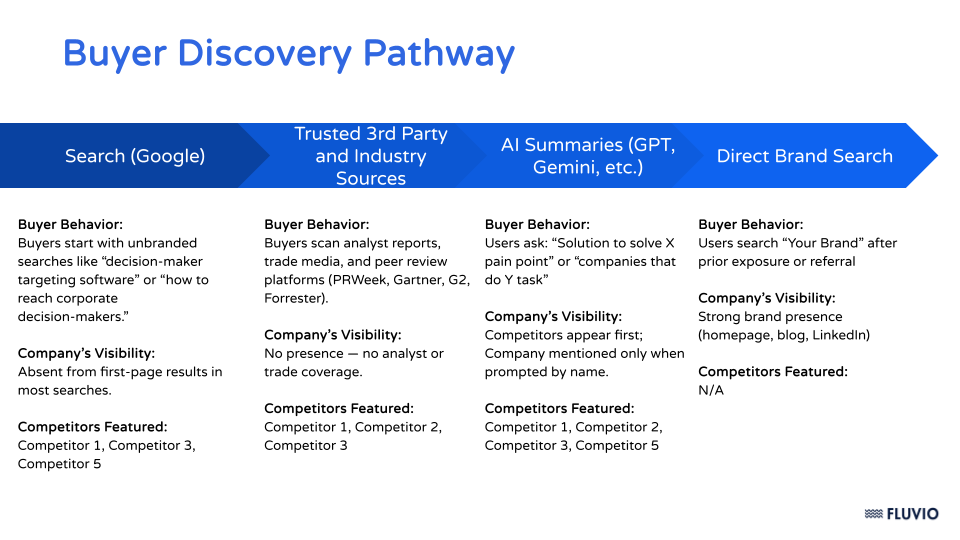
Most buyers start with a problem, not a brand. Review category, problem-based, and comparison searches to see which companies, sources, and narratives surface first. Then look at branded and unbranded search, review sites, analyst coverage, industry content, and competitor content.
From there, run the same research through AI tools like ChatGPT and Claude. Buyers increasingly use AI for discovery and evaluation, so product marketers need to know whether their company appears, how it gets described, and which competitors show up more often.
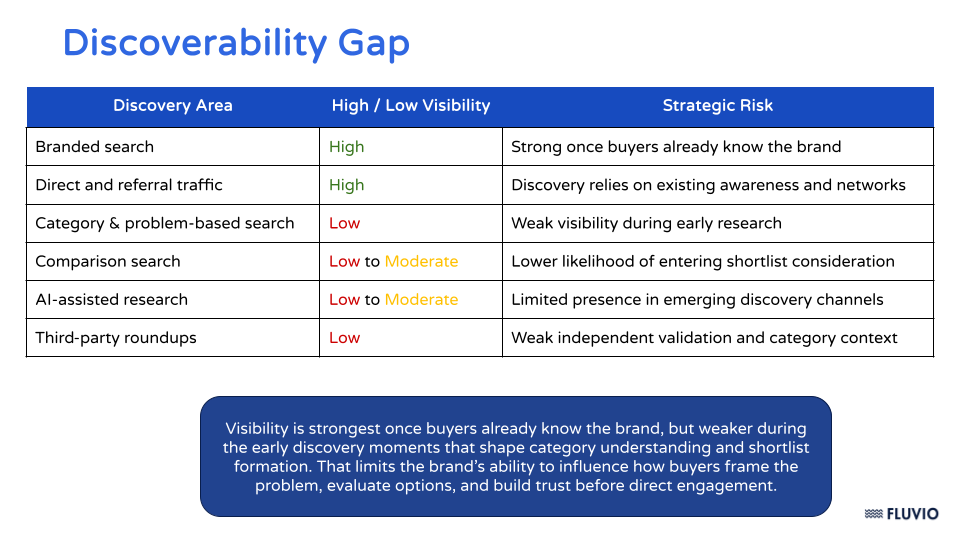
If buyers only find you once they already know your name, you are missing the chance to shape early discovery and consideration.
Analyze the narrative
Look at how your company and product are described across search, AI outputs, reviews, and industry sources. What category does the market place you in? What themes show up repeatedly? What language does the market use, and does it match your messaging?
This is where sentiment analysis becomes more strategic. You are not just measuring tone. You are understanding how buyers make sense of your company.
Compare against competitors
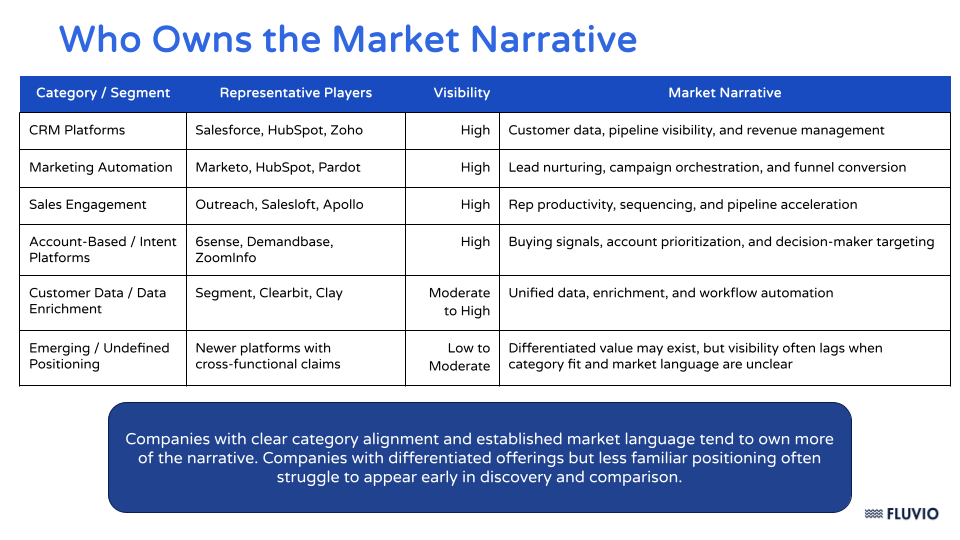
Next, look at who owns the category language, who appears most often in discovery channels, and whose framing shapes buyer expectations. Review the support behind that perception as well: press coverage, analyst mentions, customer proof, social presence, review sites, and partner ecosystems.
The goal is not just to track competitors. It is to understand who is teaching the market how to think.
Identify trust and friction
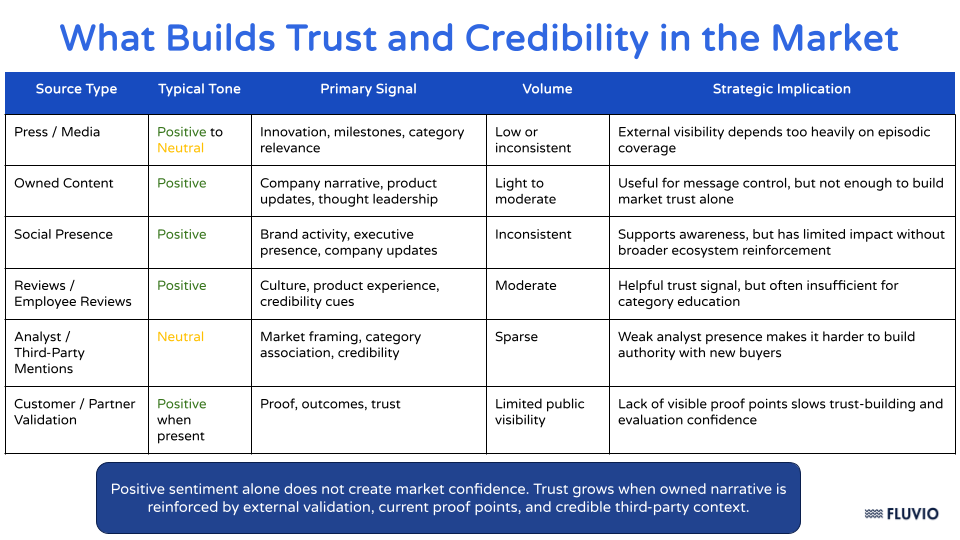
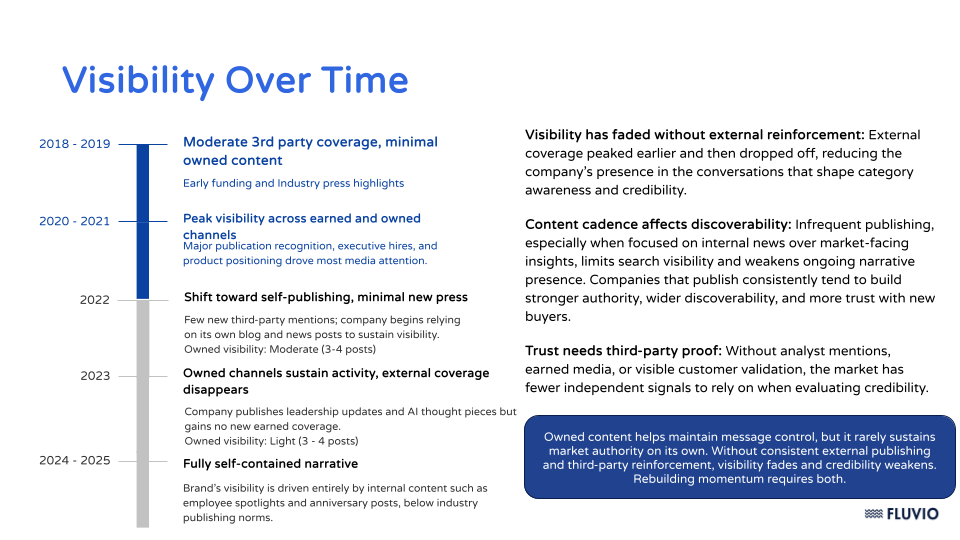
Buyer sentiment often comes down to trust and hesitation. Look at what proof buyers can find, what validation feels credible, and where gaps exist between what a company claims and what the market can verify.
That gap often explains why a strong internal story does not translate into strong market understanding.
Turn findings into action
The real value comes from what the analysis changes. A strong sentiment analysis should lead to sharper messaging, clearer positioning, better proof, stronger content priorities, better buyer journey support, and more effective sales enablement.
IV. What a strong sentiment analysis should inform
This work matters because it influences both strategy and execution.
Messaging and positioning
It helps refine category language, clarify differentiation, address confusion, and strengthen claims with proof.
Upstream GTM strategy
It can inform category design, audience prioritization, market entry, key problems to solve, launch narratives, and the broader frame through which the market encounters the company.
Buyer journey strategy
It can show where awareness breaks down, what buyers can and cannot find at each stage, and what trust gaps slow movement from curiosity to consideration.
Marketing execution
It can shape SEO priorities, thought leadership, campaign themes, content strategy, and channel focus based on where the market builds understanding and trust.
Sales enablement
It can help sales address objections, clarify positioning, strengthen competitive framing, and lead with proof that matches how buyers enter the category.
This is why sentiment analysis should not be treated as a brand reporting exercise. For PMMs, it should function as a strategic planning input and an execution enabler.
V. Best practices
Start with a buyer scenario, not a generic market scan
Use the buyer’s language, not just internal messaging
Measure discoverability along with perception
Review AI alongside search
Separate owned narrative from third-party validation
Compare direct and adjacent competitors
Tie every insight to a strategic or executional action
Revisit regularly as market perception shifts
VI. How to get started
This is part of what makes the approach so useful for product marketers: it does not require the lift of a formal VoC program, a full win/loss initiative, or a large research budget.
A PMM can do this independently with limited time and resources. Start with one ICP and one buying scenario. List the questions that buyer would realistically ask. Review what appears across search, AI tools, analyst coverage, review platforms, industry sources, and competitor content. Then compare what surfaces for your company versus competitors and document the recurring themes, trust gaps, confusion points, and narrative barriers.
From there, summarize the implications for messaging, positioning, GTM strategy, content, buyer journey design, and sales enablement. Then prioritize three to five actions.
This is a low-lift, high-leverage motion. Done well, it can elevate both the visibility and the organizational impact of product marketing.
VII. Closing
Sentiment analysis should not be treated as a brand reporting exercise. For product marketers, it should be used as a strategic input that shapes upstream GTM strategy and strengthens downstream GTM execution and sales enablement.
The companies that win do more than monitor perception. They learn from it, act on it, and use it to influence how buyers discover, understand, and trust them.
The strongest product marketers do not just measure what the market thinks. They use that insight to shape what the market believes next.