

2026 Product Marketing AI Trends Report: Faster, If Not Better
Fluvio Research led by Lyle Burns
Tools, training, and governance are now in place. Measurement remains sorely lacking
Companies proved they could roll out AI this year. Proof it paid off did not follow: the share of teams able to measure any AI impact sat at 13%, exactly where it was in 2025.
Executive summary
Product marketing turns product investment into revenue, and marketing and sales is the function where AI most often produces it¹. Two things happened to it this year. It lost the argument for AI resources: those go to whoever has quantifiable pain, a legal backlog, headcount against ticket volume. Product marketing's value doesn't show up that way, and ownership of its own AI agenda moved elsewhere as a result. Almost nobody built a way to prove the AI investment that did happen worked. Five findings show both:
What we found:
PMM leaders want to measure, but can't: 59% want to measure revenue impact and have no way to. Just 4% say they can measure what they need.
Only 13% of teams track any measurable AI impact: That number has not fluctuated from 2025, and none track revenue or pipeline.
Marketing lost influence in AI decisions: Ownership fell from 48% to 20% in a year. IT and central functions rose from 30% to 56%.
AI made teams faster, not smarter: AI use has stayed concentrated in gathering and producing, not in decisions. Output looks finished on the surface, but team leaders are absorbing the review it takes to catch what junior staff can’t judge and other functions don’t want to spend time on.
Internal standards are higher than what’s getting shipped to the market: Teams are wary of and hesitant to accept “AI slop” in internal communications, colleagues’ drafts, or other deliverables, but send AI-generated copy, graphics, landing pages, messaging, decks, and products to market anyway.
How we did this
Survey of product marketing practitioners, fielded July to September 2026.
Interviews across software, fintech, banking, payments and consulting.
What this looks like on the ground
AI is teaching teams to skip the people who catch their mistakes
Most corporate AI use carries a culture and expectations. Move faster, stop waiting, and remove the need to file a ticket to get a job done.
Moving fast comes with its own risks, predictably: review steps start to look like a burden, so people stop asking and ship without internal alignment.
At one company interviewed for this study, the product team got a frontier model months before marketing did. The product team built their own landing pages, which looked finished but connected to nothing. No CRM, no automation, no lead capture. Marketing found out weeks later and then had to allocate time to cleaning it up.
“AI-generated landing pages just weren’t helpful, because A, they didn’t fit our style, B, they didn’t fit our messaging, and C, they didn’t have any backend connectors. They don’t connect with our CRM or with Marketo.”
Why this matters
Product marketing should be helping to define business strategy and connecting it to execution
The landing pages in the scene above did not fail because AI is bad at building landing pages. They failed because the strategic elements behind them weren’t addressed: what the company's differentiation actually is, who the page was for, how it was meant to connect to the systems that turn a visitor into a lead. AI helped build faster but didn’t account for the thinking which happened before the asset creation started.
Fluvio has written before about product marketing as business strategy, mapped against the five questions in Roger Martin's "strategy cascade” from Playing to Win: How Strategy Really Works. Every company has to answer these to compete, and product marketing should be best positioned to provide those answers.
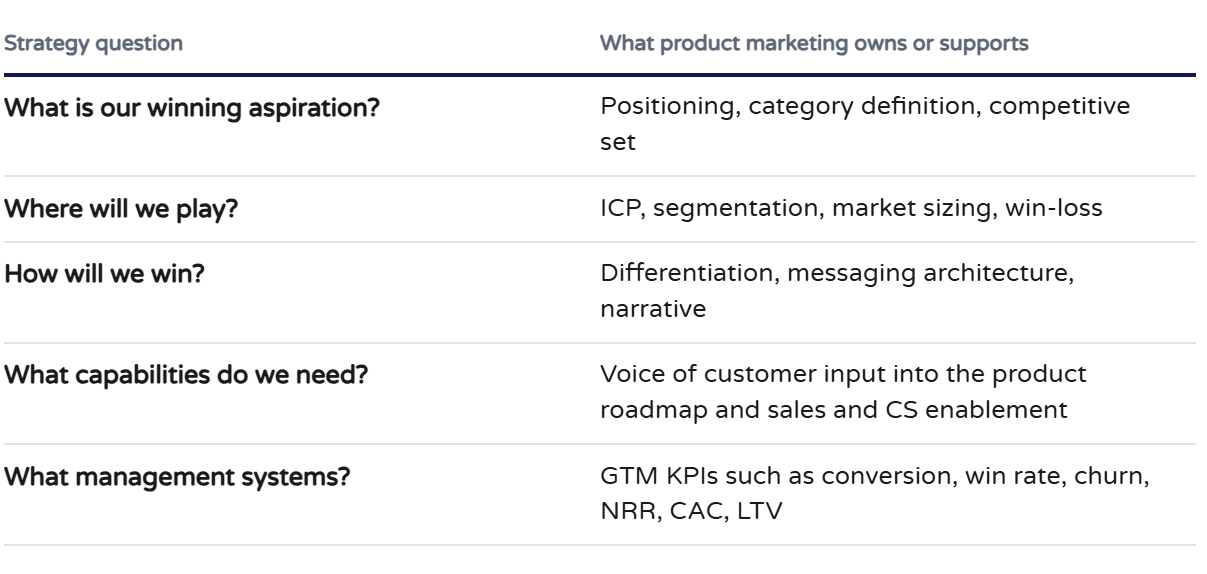
Product marketing is a strategy role, not a marketing support function. Treating it as the latter creates the disconnect between what companies say about the discipline and how they actually resource it.
What companies say:
43% report strong executive alignment on product marketing's importance.
30% report being viewed as an important strategic partner by executive teams.
What companies do:
Only 10% report consistent involvement in early-stage decisions, where elements like the five questions above actually get answered.
This problem predates AI, which has served to compound it. A team that arrives after the decisions are made can’t reasonably be credited for the results those decisions produced, no matter what tools it has.
Finding 1
Every maturity metric improved…except proof points
Our 2025 report recommended leaders prioritize three things: centralize AI ownership, set governance, measure outcomes. Six metrics associated with ownership and governance demonstrated significant improvement in these last twelve months, but measurement indicators remained stagnant.
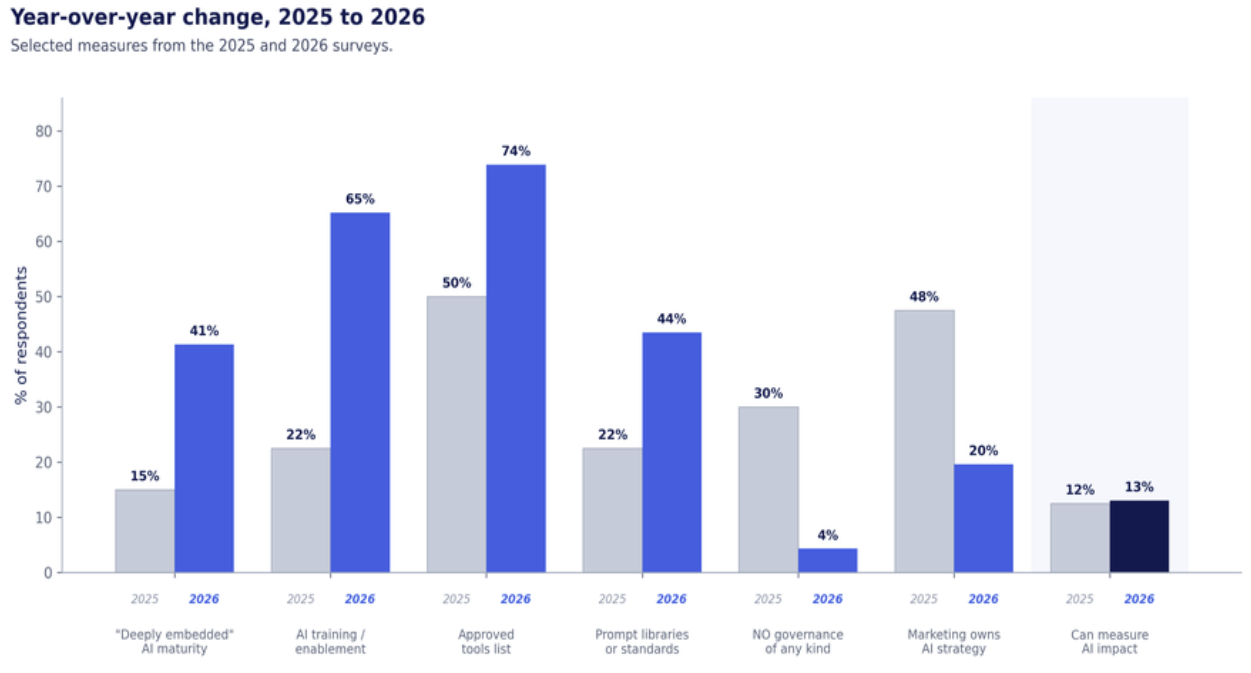
Governance and measurement turned out to be unrelated in practice.
We recommended centralizing ownership. AI ownership was moved to IT teams in many organizations, who are less likely to measure market outcomes unless instructed to by leadership at the outset.
Adoption is done: 89% use AI daily, up from 82.5%. 91% expect to use more.
Governance and training were prioritized: Companies with no AI governance fell from 30% to 4%. Training nearly tripled, 23% to 65%.
Centralization became more common: Central ownership rose 30% to 56%, exactly what we recommended in 2025.
Measurement stayed flat: 12.5% to 13.0%.
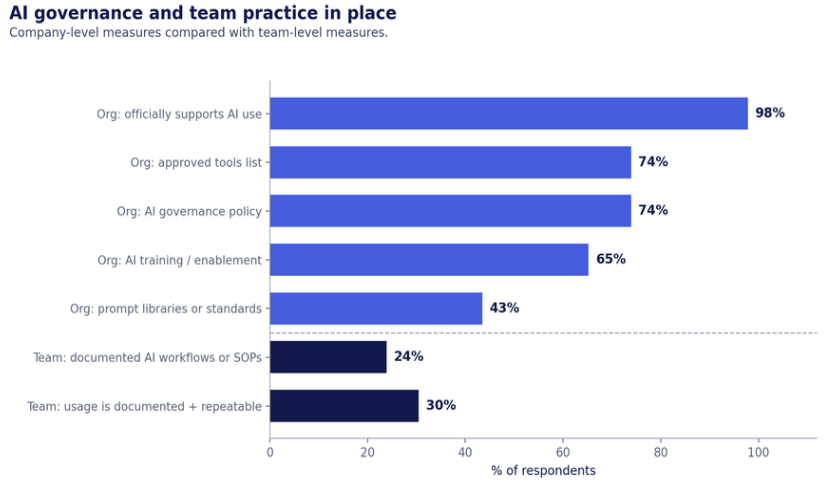
We also see a self-assessment problem, as 41% of respondents call their company "deeply embedded" in AI yet only 9% have documented, repeatable team workflows. Respondents are describing company infrastructure and reading it as functional maturity.
Across interviews, including at the two most AI-mature companies in the study, we found no team with genuine outcome measurement. Several described usage reports and course completion as their metrics. AI now sits with IT teams that have no revenue mandate, so the things measured are usually: usage, tokens, and licenses.
Finding 2
Teams want to prove value
A flat measurement number alone would indicate that organizations don’t care to measure AI performance. Our data says otherwise.
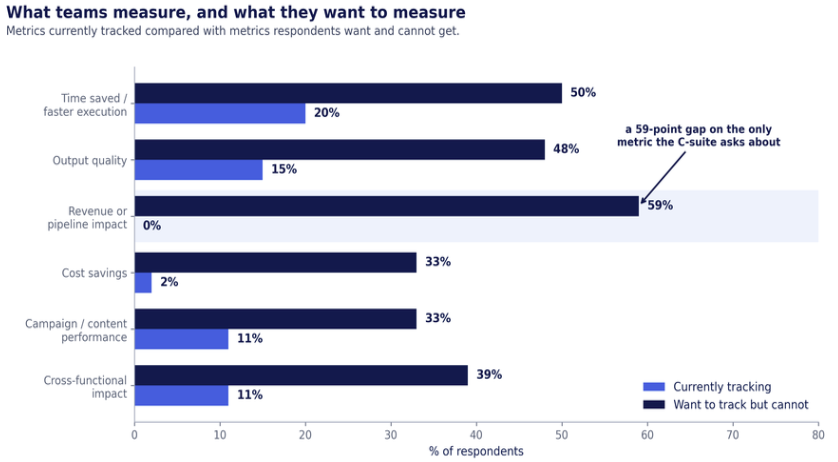
Inability to measure performance is driven by three common factors:
No instrumentation: 59% want revenue or pipeline impact measurement but can’t get it today: with only 4% stating they can measure what they need.
Disconnected systems: 48% listed integration as their top barrier to deeper AI use.
PMM is involved too late to claim credit: The same 10% figure from earlier shows up again here as a measurement problem. A function that isn't in the room when decisions get made can't cleanly attribute outcomes to its own work.
These are areas where product marketing has room to act with the least friction: none of these should require requesting budget or engineering time.
Metrics worth tracking should tie to revenue, and right now that number is zero: not one company in this study currently tracks revenue or pipeline impact as a metric. Three measures follow that PMM can start on now. Each has to isolate AI's contribution specifically, separate from other signals and noise.
Competitive win rate against a specific competitor, tracked before and after that competitor's battlecard is rebuilt with AI assistance. We recommend starting here as most CRMs already log win rate by competitor, and the rebuild date is easy to log too, which gives a clean before-and-after.
Win rate on deals using AI-assisted enablement, against deals using enablement built without AI. If the battlecard or one-pager is generated through a skill or custom GPT product marketing built and maintained and tracked in an enablement platform, every use can be logged automatically.
Sales cycle length in segments using AI-assisted messaging, against segments using messaging built without AI. A shared LLM skill grounded in product marketing's positioning and competitive inputs, that sales uses to generate a talk track or get coached on a synthetic persona, produces measurable usage data.
67% of teams in this study have already built a custom GPT, skill, or assistant for their own use. None reported building one specifically for another function to consume, which is a clear opportunity.
A skill built from product marketing's inputs and handed to sales is the literal version of "become the source, not the checkpoint," a recommendation we make later in this report. Doing so provides value through effective, validated sales enablement, and makes its use quantifiable.
Other measures are operating measures, and should be labeled as such. They give insight into whether AI is helping and allow PMM leaders to adjust AI strategy, operations, and workflows to improve performance. Examples:
Time from an approved creative brief to a published asset. A brief here means the one-page direction a PMM signs off before a designer or writer starts, whether AI-assisted or not. Tracking this specifically for AI-assisted work against non-AI work is what tells you whether AI is actually shortening the path to market, not just producing more drafts.
Revision passes before a deliverable ships to market, meaning before a launch page, deck or campaign asset goes live. Rising revision counts on AI-assisted work are an early sign that speed is being spent on cleanup, rather than necessarily saved.
Segments or personas that now have dedicated material where none existed before. This is the clearest sign that leveraging AI has expanded real coverage rather than just adding volume to existing work.
Rather than proving revenue impact, these measures build a track record for exactly the AI-specific work product marketing controls. Paired with the revenue-linked numbers above, it turns "we think this helped" into a case a CFO will engage with.
Finding 3
The people closest to your customer are furthest from your AI decisions
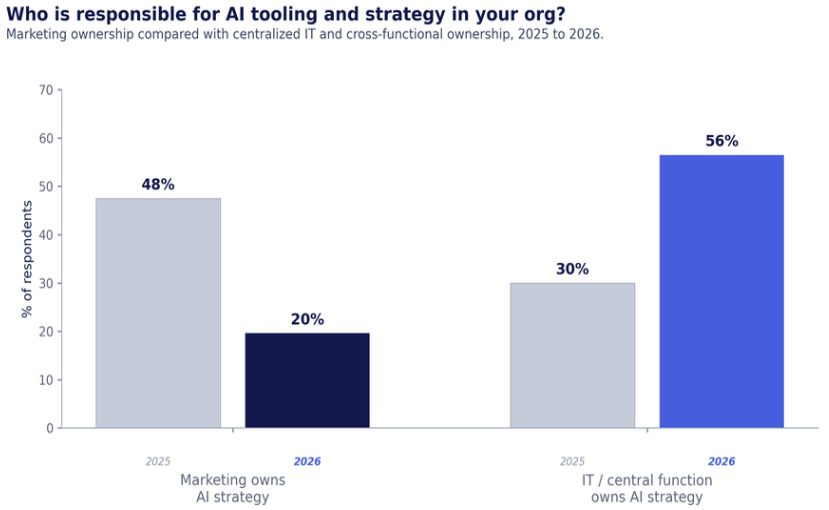
The reason behind this is simple. AI capacity goes to whichever team can put a number on its problem, such as Support or Legal: hours per recurring request, a ticket backlog, headcount against workload. Call it quantifiable pain. Product marketing's contribution is real but spread across functions and measured after the fact, so it arrives at the resourcing conversation with a strategic argument and loses to a team with a spreadsheet.
Marketing ownership of AI fell 48% to 20% in a single year. Central IT and cross-functional rose 30% to 56%.
Marketing and sales is where AI most often produces revenue. McKinsey's 2026 State of AI survey, with 1,719 respondents across every business function, ranks it first for reported revenue gains from AI, ahead of product, engineering and operations.
28% do not know how AI tools are evaluated at their own company.
Product marketing is served last when AI gets funded.
At one mid-size software company, a product marketing team's own AI tooling budget was refused on the grounds that it was not something you would build for a single team.
At an enterprise fintech company, the AI transformation office scoped product marketing's requests, then built for legal and RFP use instead.
“It’s almost like a race for tokens. You guys just keep doing your own thing, you don’t need all these tokens, other areas of the business need them more than you guys do.”
Finding 4
AI made teams faster. It did not make them smarter.
AI output often appears attractive, and hides a weak structure underneath. Catching the difference takes expertise. Remove the expertise (i.e., review by a seasoned product marketer) and you ship materials with lower quality.
AI did the research and the drafting rather than driving decisions. As Finding 5 below describes in detail, AI use stays concentrated in gathering and producing, research, drafting, first passes, and thins out fast at the decision stage. Producing the same kind of work faster is not a recipe for a smarter team.
Where extra time did appear, it went to checking LLM’s work. 46% of respondents report spending more time on strategic work. But 71% of that same group also report increased output volume and 76% also report a wider range of responsibilities. In our interviews, the product marketers who felt this most directly were team leaders. Junior staff can produce far more with AI but cannot always tell good output from confident-but-wrong output, so review burdens concentrate on whomever on the team can.
As one head of marketing put it, content production "is only as good as the level of expertise of the folks actually creating it.” Another leader called this the expanding job of the "taste arbiter."
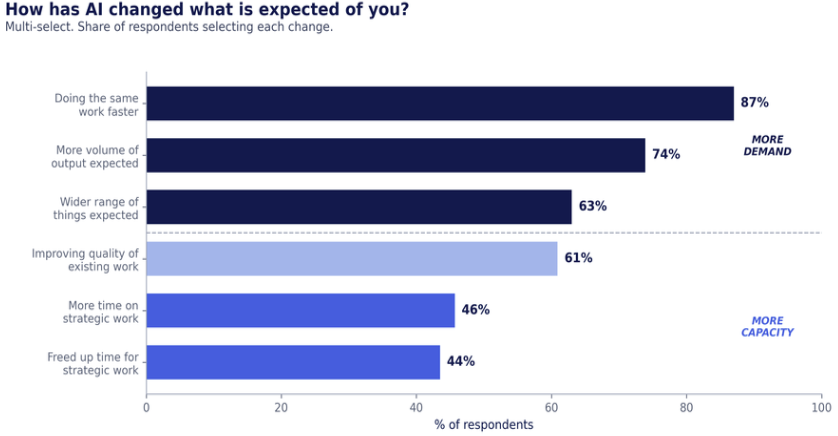
Demand rose roughly 1.7 times faster than capacity.
87% do the same work, faster. 74% face more output expected. 63% have a wider range of responsibilities.
Faster, busier, and not further ahead. That combination is what our finding of "not smarter" refers to. Throughput went up, judgment didn’t improve, and the delta is the work senior reviewers are absorbing.
“Everyone is just asking more and more of PMMs, but we’re not necessarily getting more help, because the AI is supposed to be the help.”
The strain
Our in-house research reports continue to demonstrate a trend: high expectations, fewer resources
The strain placed on Product Marketing did not start with AI. Three 2026 Fluvio studies, with three different focus areas, have produced consistent insights:
PMM Revenue Gap Report: product marketing enters after the decisions that determine revenue. Only 7% of companies see the function as a strategic revenue driver as a result, PMM becomes a function without the standing or leverage to push back when more gets added to its plate.
PMM Hiring Trends Report: scope is expanding faster than support. 41% of new hires say the role was not realistic for one person. 87% call resourcing inadequate. Notably, zero respondents described their success metrics in their new role as “very clear.”
This study: AI added work volume without adding capacity, and moved the tooling decisions to other functions.
Together they describe a function being asked to carry more, with less strategic input, and with less ability to show what it produced.
“The size of the team is definitely getting smaller because there’s the overall assumption that I’ll give you AI, and you’ll be able to do more. AI’s not there yet, but they will downsize the teams now and see what happens.
”
Pain points differ by level and reflect nuances in what individual contributors and team leaders are managing.
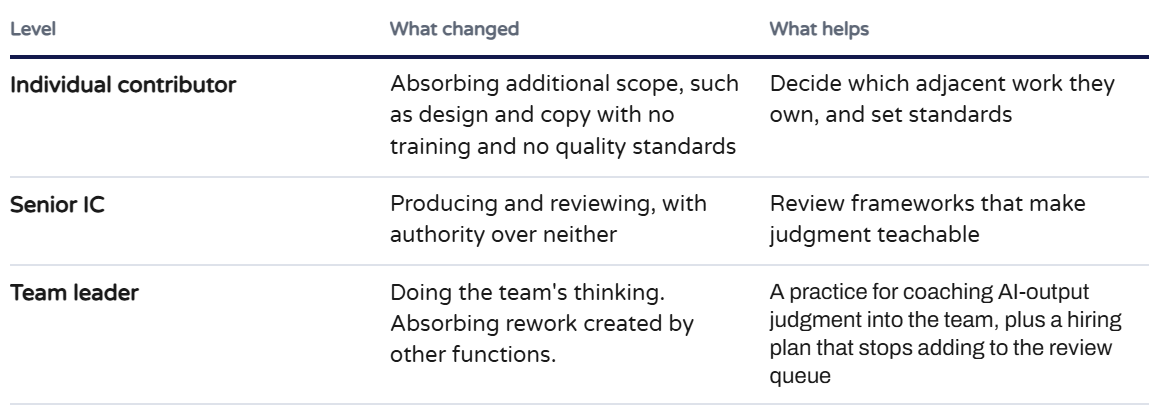
More AI volume from a junior team means more senior review time, so adding cheaper early-career headcount can make the bottleneck worse. Senior product marketers end up with less time for customers and less time for high-impact work.
Finding 5
Product marketers are more likely to use AI to gather context and to produce content than to make decisions
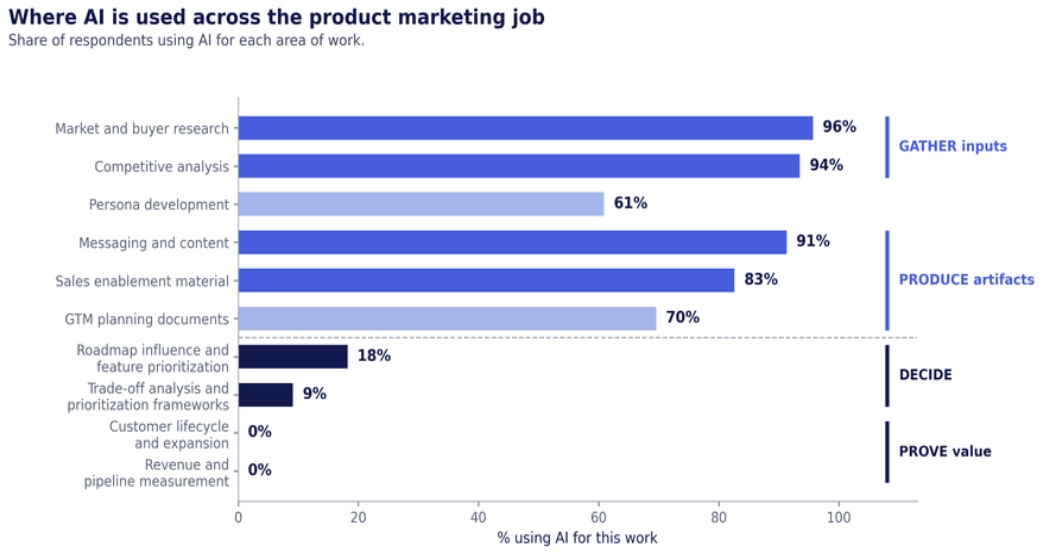
Why that matters:
It explains the measurement gap: If AI use is concentrated in content and research, it’s tough to translate that work to a revenue impact. Research and content does not carry an attribution trail the way a competitive win or a shortened sales cycle does.
It turns high adoption into a warning about how AI is applied: 89% report daily use, but the effort concentrates in the least strategic part of the role.
It collides with the biggest growth lever: Roughly 80% of value creation at fast-growing companies comes from existing customers, per our research behind our case for investing in product marketing. AI use in customer lifecycle work was reported as zero across our respondents.
Strategic assets, such as a maintained positioning platform, a written decision framework, structured customer evidence, create the context that makes AI outputs effective.
Every respondent has a general-purpose chat tool. 94% use Claude, up from 40% in 2025, the largest single-tool shift in either year of this study.
Very few have AI wired into a core business system (Salesforce AI 11%, HubSpot assistant 15%).
Two-thirds use no specialized research or competitive intelligence platform.
63% cited integration, skills, or data access, combined, as their top blocker. Only 9% say cost.
General-purpose chat tools are just the starting point. Newer agentic products can connect directly to a company's own systems, something chat tools can't do. Most respondents in our data haven't adopted those connected tools yet.
A thread through our findings: product marketing's AI use concentrates in research and drafting, the two things general-purpose chat tools do well. Integration is what could change that. Without it, AI can't reach the systems that connect to revenue-facing work like customer expansion or roadmap prioritization, or effectively measure the impact of the work it's already doing. So AI stays confined to the work that's hardest to attribute, which is part of why the measurement gap persists.
This was also apparent in last year’s report, with one director reporting: "I do not think we will get budget to invest in specialized tools so we're exploring how to leverage existing internal tools." Twelve months later, the tooling profile has barely changed, and the work hasn’t either.
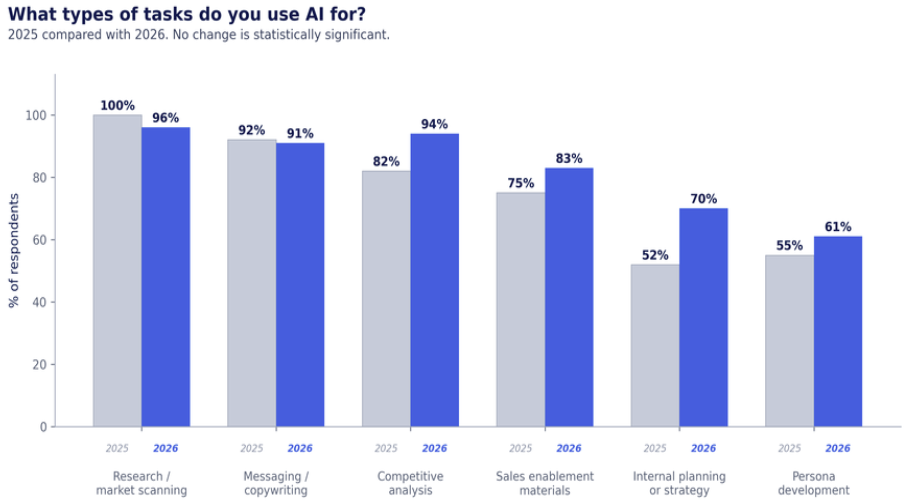
In a year when governance tripled, training tripled and maturity nearly tripled, the application of AI didn’t experience a significant shift .
Finding 6
Ownership predicts which PMM teams get to real measurement
Using our findings, we developed a new view into the use of AI: The AI Operations Maturity Spectrum for Product Marketing. Most teams clear the first two gates and stall at the third.
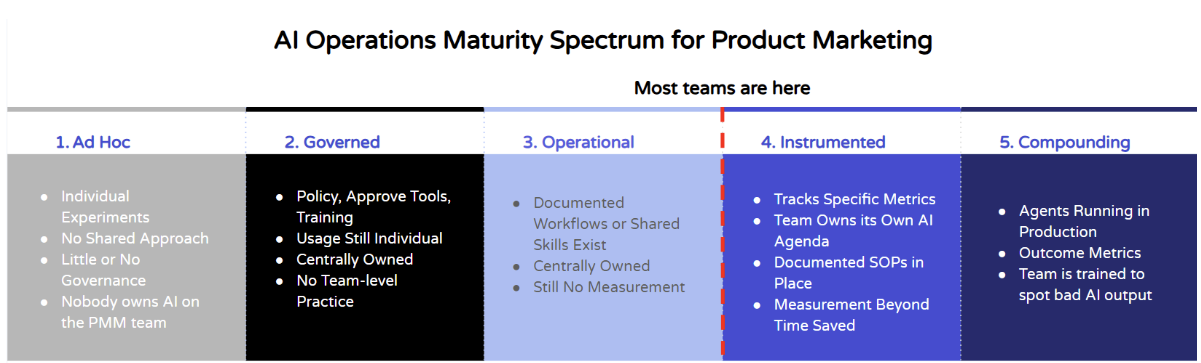
Stages are a constructed index with cumulative gates. 80% clear governance. 63% clear team practice. 11% clear measurement.
Governance is no longer the issue: Four in five teams have governance in place.
Measurement is the problem: 52% of respondents sit at Stage 3: documented workflows and no measurement.
AI strategy ownership predicts who gets past the barrier: All teams at Stage 4 or 5 own their own AI agenda.
If your team is at Stage 3 or below, more governance and more tooling may not help. The next priority should be measurement, and you are unlikely to get to effective metrics while another function owns the internal AI agenda.
The two teams at Stage 5 share judgment transfer. By this we mean the standard for telling good AI output from confidently wrong AI output has moved out of experienced leaders’ heads and into a repeatable practice the rest of the team can use.
One interviewee described running this as:
Treating every round of edits as training data, and
Feeding the specific corrections back into the tool as explicit guardrails instead of just fixing the output once.
Stage 4 teams measure outcomes but still depend on one reviewer to catch what AI got wrong. Stage 5 teams don't, because the standard has been fed back in enough times that it holds without them.
"I see this current phase as training, not just for the team, but also for the AI itself, it's getting better and better, it's compounding over time,” said a head of marketing.
What to do
Build inputs before automating
To show where AI is worth applying, we plotted every use case in this study by business impact and by whether the inputs to do it well already exist.
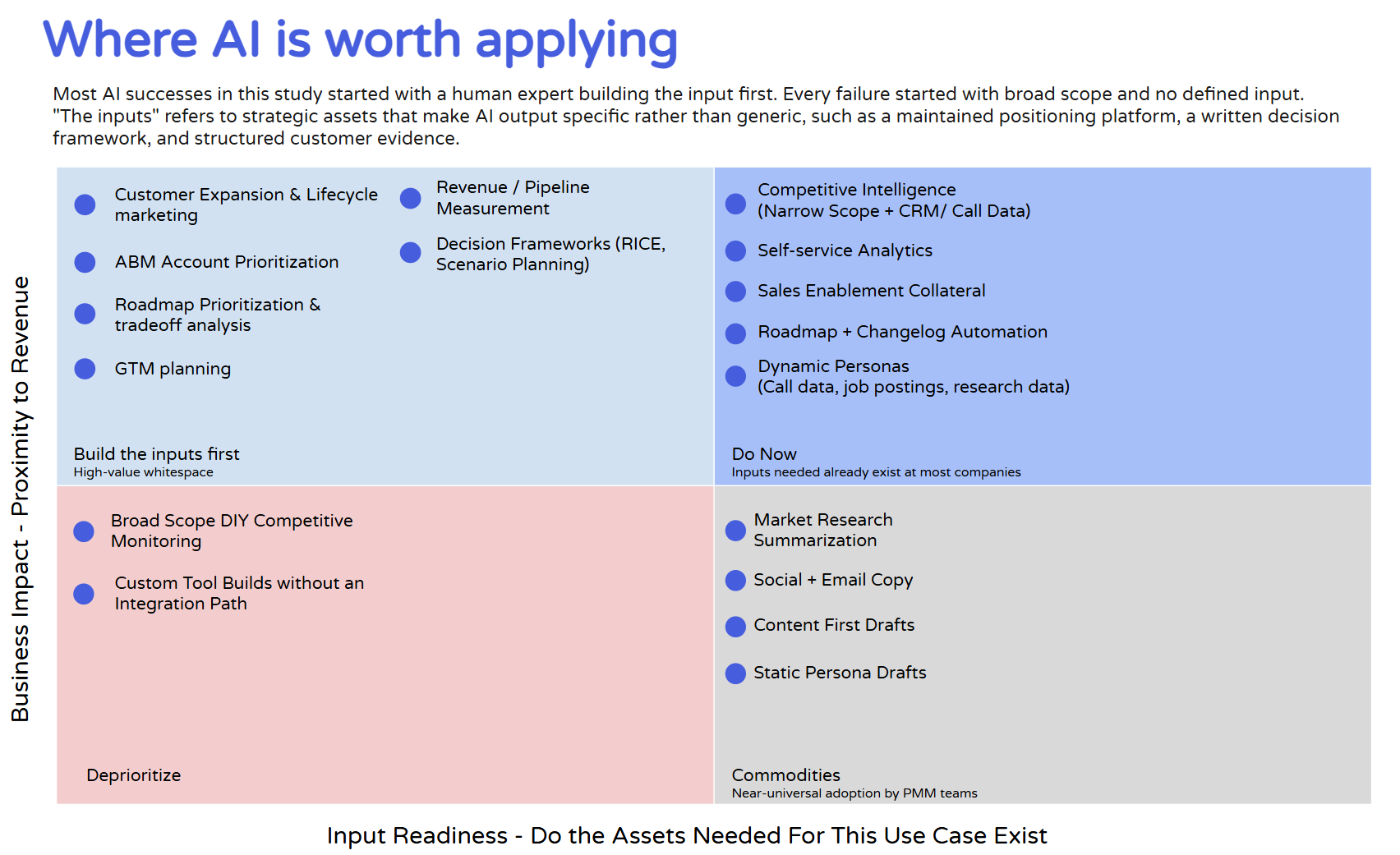
Adoption sits in the bottom right. The value sits in the top left, dependent on assets most companies have not built.
Do now: Narrow-scope competitive intelligence, sales enablement, self-service analytics, roadmap automation, and synthetic personas.
Already a commodity: Content drafts, research summaries, social copy, and static persona drafts. Most PMM teams are already doing these tasks.
Build the necessary inputs first: Customer expansion, revenue measurement, roadmap prioritization, decision frameworks. This is high value whitespace for strategic AI application.
Deprioritize. Tasks that tend to be a resource drain with minimal impact, such as broad-scope DIY competitive monitoring and custom internal tool builds, like a homegrown competitive-intel bot, with no integration path.
Each of the above use cases assumes that the strategic assets needed to inform them already exist. These are what make AI output specific rather than generic.
Competitive intelligence in focus
94% of product marketers use AI for competitive analysis. 67% own no purpose-built tool for it.
What’s worked: Narrow the set to competitors that affect deals. Feed the model call recordings and CRM records on a schedule.
What’s failed: Broad category scope and open web retrieval. A general model holds no index, so token use spirals and quality degrades as the set widens.
Five habits that raise the quality of AI outputs
Based on our own experience using AI across numerous client engagements with leading product marketing functions, and consistent with what worked across interviews:
Load the context before the task. Establish the objective, audience, constraints, and an example of what good looks like, before asking for the output.
Require traceability. Every number should be tied to a source so that every claim to evidence can be verified.
Build the structure yourself. Decide the argument and sequence first, and use your outline as the instruction set for AI.
Make the model argue with its last answer. Ask what it overweighted and what it would say from the opposite position. Provide your own perspective, expertise, and feedback to supplement and push the output further.
Reconcile two sources instead of averaging them. Disagreements usually expose the finding that tells the real story.
Four areas where AI creates poor outputs:
AI takes a strong position because you asked for one, including when your framing is wrong.
AI chases interesting-looking data cuts that correlate to nothing.
AI over-reads small samples without flagging them.
AI mistakes a demographic split for a finding.
Each is easy to catch once you know what to look for. Building that judgment across a team, not just holding it yourself, is exactly what the coaching practice below is for.
Helping others leverage PMM value via AI
Cross-functional teams should use AI to create content. Doing so without validated inputs creates risk.
When teams bypass product marketing entirely and use AI to build landing pages, pitch decks, battlecards, or launch narratives, the strategic value PMM would have added is lost.
Enablement assets are the most visible output of positioning, segmentation and voice of customer work. When other teams don’t perceive the strategy work as PMM’s value and perceive it instead as a content factory, they often consider AI to be a useful way to get what they want, faster. The result is confident, well-formatted…and off-base in ways that will be instantly clear to a buyer.
The freedom for sales and customer teams to generate their own materials can be a real benefit, freeing up product marketing's time for higher-impact work. Four tactics help other teams' AI output stay on-brand:
Four tactics which improve AI outputs generated by cross-functional teams:
Own and share the key inputs. If product marketing supplies the messaging framework, ICP, positioning platform and competitive briefs that everyone else's AI prompts run on, enablement built from them uses the best possible framing.
Use AI to keep materials fresh. The materials most exposed to industry shifts, like battlecards, should be updated with AI as competitors and the market move.
Know who sets AI standards at your company. Working with them directly ensures the guidelines reinforce PMM's value across every use case they touch.
Get into decisions earlier. Once AI can produce a page or a deck at almost no cost, the scarce thing left is judgment about what it should say, and that's a product marketing skill, not a production task.
Recommendations
What to do, by level
Chief Marketing Officer
Claim the AI agenda or ensure influence on it before it settles elsewhere permanently.
Update the hiring and development plan. Junior headcount on an AI-amplified team increases the senior review bottleneck. Budget for training junior staff in AI-output judgment, or make sure senior capacity exists to absorb the load.
Bring quantifiable pain to resourcing conversations: hours per recurring request, volume handled manually, cost of the workaround.
Product marketing leadership
Start tracking cycle time, rework passes and coverage this quarter.
Build the strategic inputs now: a messaging and positioning platform, a written decision framework, a proof library.
Moving upstream requires trading time, not finding free time. Our data shows leaders already absorbing more review work, not less, so this only works alongside a thoughtful coaching practice that moves some of that review off your desk first.
Individual practitioners
Structure before you generate. Build the outline and use it as your prompt.
Protect your own quality standard, including periodic work without AI. Market depth is the reason you get hired, and the part that does not commoditize.
Differentiate from your peers by delivering content that reflects your unique insights and voice, accelerated by deft use of AI tools.
What happens next
Six capabilities to add before FY28 planning
Next year's maturity question will be focused on where AI spending produced measurable impact. So, prioritize adding:
Maintain a positioning platform and narrative. Current, owned, dated, and available for other teams to build on.
Structure customer evidence. Voice-of-customer research organized so a system can query it.
Create a written decision framework. Set clear criteria for what AI-assisted work needs product marketing review, and what needs product marketing leadership review.
Connect systems. 48% of respondents named integration their top barrier. Fixing it takes a cross-functional push.
Track one quality and one throughput measure of PMM's AI use. One signal for whether the work is any good, one for whether it's actually faster, tracked long enough to mean something.
Develop a practice for coaching AI-output judgment into the team. Coaching the team on what good looks like frees up senior PMM time and lets the team scale.
The AI high performers in McKinsey's report are roughly twice as likely to have defined processes for quantifying AI impact.
“If somebody comes out and says this is the way to do it, that would be immensely helpful. Where to start? Do I hire a GTM engineer? Do I hire a consultant? I don’t have time to figure it out on my own.”
Where Fluvio fits
We help teams accelerate go to market, including building relevant inputs and operationalizing their use. Positioning platforms, ICP and persona definition, competitive programs, messaging architecture, and the voice-of-customer research that makes them actionable. If your company is also repositioning around AI capabilities, the pivot adds a second problem on top of this one: an identity question, an installed base at risk, and a sales team improvising the story. Our AI go-to-market practice handles that specifically.
Curious where you stand? Reach out to our team or start with a Fluvio GTM Assessment.
OUR POSITION
By the FY28 planning cycle, product marketing teams that cannot answer what AI investments returned will stop being asked. They will be resourced as an execution function.
The above outcome is avoidable. 59% of product marketers want to prove revenue impact and cannot. What's missing is instrumentation, and the first elements don't need anyone's permission or budget to build. PMM has to put this in place on its own, and start before the question gets asked.
External sources.
McKinsey & Company, "The State of AI in 2026: On the Road to ROI," August 2026 (survey fielded May 4–June 8, 2026, n=1,719).
Fluvio's 2026 Revenue Gap and Hiring Trends research reports
Fluvio-authored content, including Playing to Win and product marketing investment articles.