

Why product marketing struggles at startups (and it's not who you hired)
WRITTEN By Fluvio consultant, Marsha Kim
There's a pattern in startups: the leadership team makes a serious investment in product marketing and expects the new hire to sharpen positioning and accelerate pipeline. Six months later, product and feature launches still don’t seem to be moving the needle, and the team feels a growing sense that the function isn’t delivering on its potential.
The instinct is to question the hire. Was this person the wrong fit? Did we move to address the problem too late? And frequently, do we even need a PMM at this stage?
These are all fair gut reactions. But in our experience, they’re rarely where you’ll find the answer to the underlying problem.
What's usually at the root is the shaky structural foundation for product marketing success; not the talent. But the great news is that startup leaders, especially those who are already set on bringing in a product marketer because they see the intended value of the function, are in prime position to address and stabilize this infrastructure, right from the start.
It comes down to two axes:
When PMM enters the decision-making process
How clearly the function's charter is defined
Get these two conditions right, and even a first-time PMM hire can build meaningful momentum. Leave these guidelines unaddressed, and even the most experienced product marketer will struggle to deliver the impact you're both hoping for.
Before we get to the framework, it's worth understanding why the mental models most startup leaders default to make this harder than it needs to be.
The common problem with mental models of startup product marketing
Most startup leaders seek out product marketing support through necessity: A launch needs a narrative. The sales team needs a deck. The website needs a targeted refresh. These are all real gaps, with real timeline pressures. But this limited mental model of PMM is almost entirely executional; and when that's the lens leadership hires through, the function gets scoped to its lowest-leverage version from day one.
The enterprise PMM model doesn't solve this either. Dedicated competitive intel teams, six-month launch calendars, 40-slide messaging frameworks; that version of PMM is built for scale, risk management, and incremental optimization. It is not built for early-stage speed and ambiguity. Importing that approach into a startup creates process without momentum.
So neither model fits. The executional model caps PMM's impact. The enterprise model slows it down. The function is real and the impact is real; however, the models you’ve tried out or seen elsewhere just aren’t the right fit for your high-growth, agile context.
PMM, at its core, connects what the market is telling you to how your product is built, priced, and positioned before those decisions are locked in and while there's still room to act on what you learn.
The question you should hone in on at your startup isn’t "How do we build a great PMM function?" but rather "What does great PMM look like for a company at our stage, with our ambitions, moving at our speed?"
Market data makes clear why the answer to that question matters, and how costly it is to get wrong.
PMM's impact gap: what the data shows
Poor product-market fit (PMF) is the leading cause of startup failure, with a CB Insights' analysis citing it as the primary cause of failure in 43% of 431 failed VC-backed startups post-mortems. Lack of PMF is a market understanding problem as much as if not more than it is a product problem; it’s something that arises when assumptions a company builds and strategizes on turn out to be fundamentally misaligned with customer characteristics, needs, appetite, and behavior.
Product marketing, at its core, is the function built to surface and pressure-test those assumptions before they calcify, extra crucial for startups with limited resources and runway to “get it right.” When product marketing is under-empowered, founders and product teams fill the gap with intuition, conviction, and anecdotal evidence, which may hold until the first pricing objection appears or the third deal is lost to a hidden competitor.
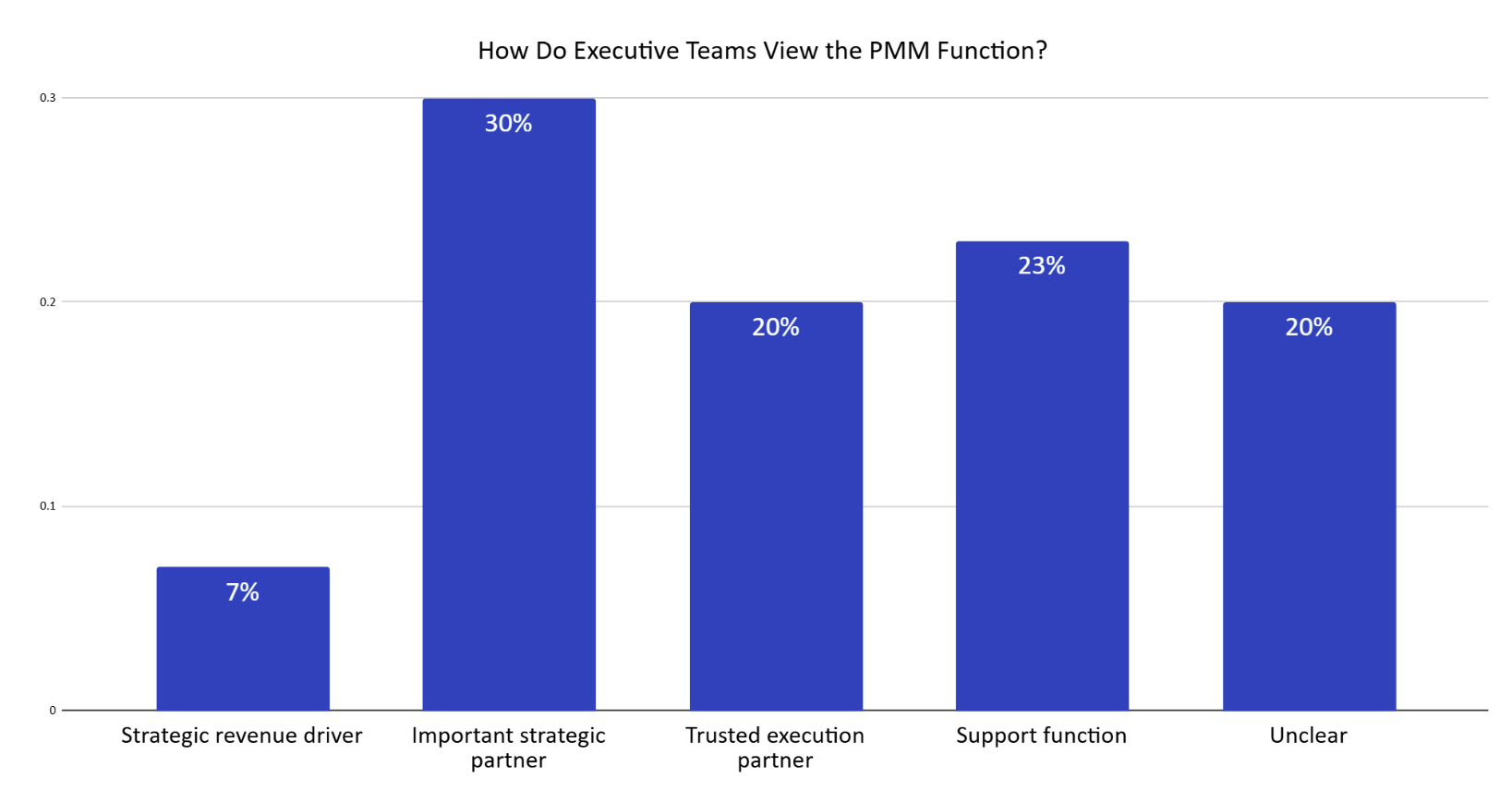
“PMM is expected to drive revenue…but only 7% are treated that way.” Fluvio’s 2026 PMM Revenue Impact Survey puts numbers to this dynamic:
Only 7% of PMMs report being viewed by leadership as a “strategic revenue driver.” The rest feel categorized as execution partners, support functions, or unclear in mandate entirely.
Separately, 70% of PMMs say they aren’t confident their work influences revenue outcomes, particularly because the structural conditions don’t give them a clear line to draw.
This effect is especially acute at startups, where there's no inherited GTM infrastructure to absorb the misalignment.
It’s not just lack of revenue-focused direction but also being torn in every cross-functional direction to plug gaps and put out urgent fires. Fluvio’s 2026 PMM Revenue Impact Survey asked PMMs what share of their work directly drives revenue.
The majority of PMM teams report spending only 25–50% of their time on work they believe directly impacts revenue. The rest of their calendar goes to reactive execution on workstreams that don’t compound.
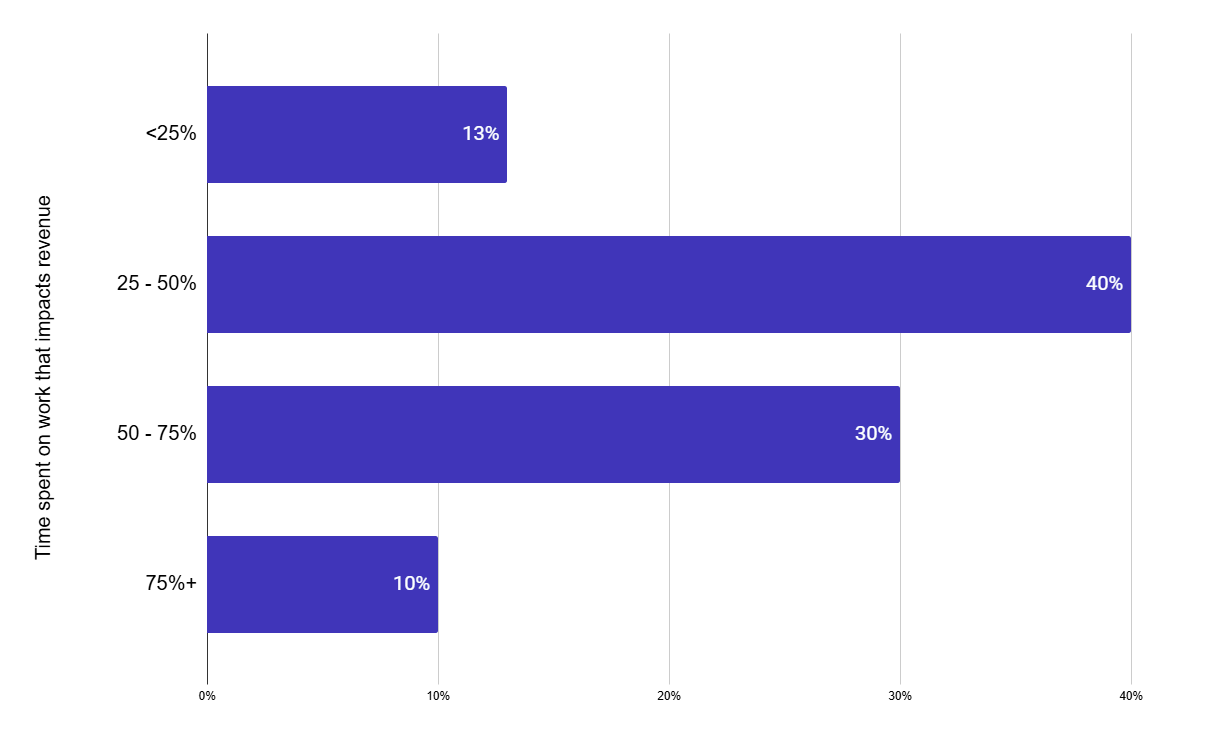
70% of industry PMMs can't connect their work to revenue and most are spending less than half their time on work that compounds, and startups can’t afford to learn this lesson the hard way. But on the flip side, being early also means that conditions for PMM success are still malleable, and there is a ripe opportunity to adjust and “get it right” before GTM processes and assumptions become concrete.
The Startup PMM Conditions Matrix
Across our work with startups at different stages, two variables consistently determine whether a PMM investment pays off: when PMM enters the decision-making process (timing), and how clearly the function's scope and mandate is defined (charter). Every startup's PMM situation maps to one of four states.
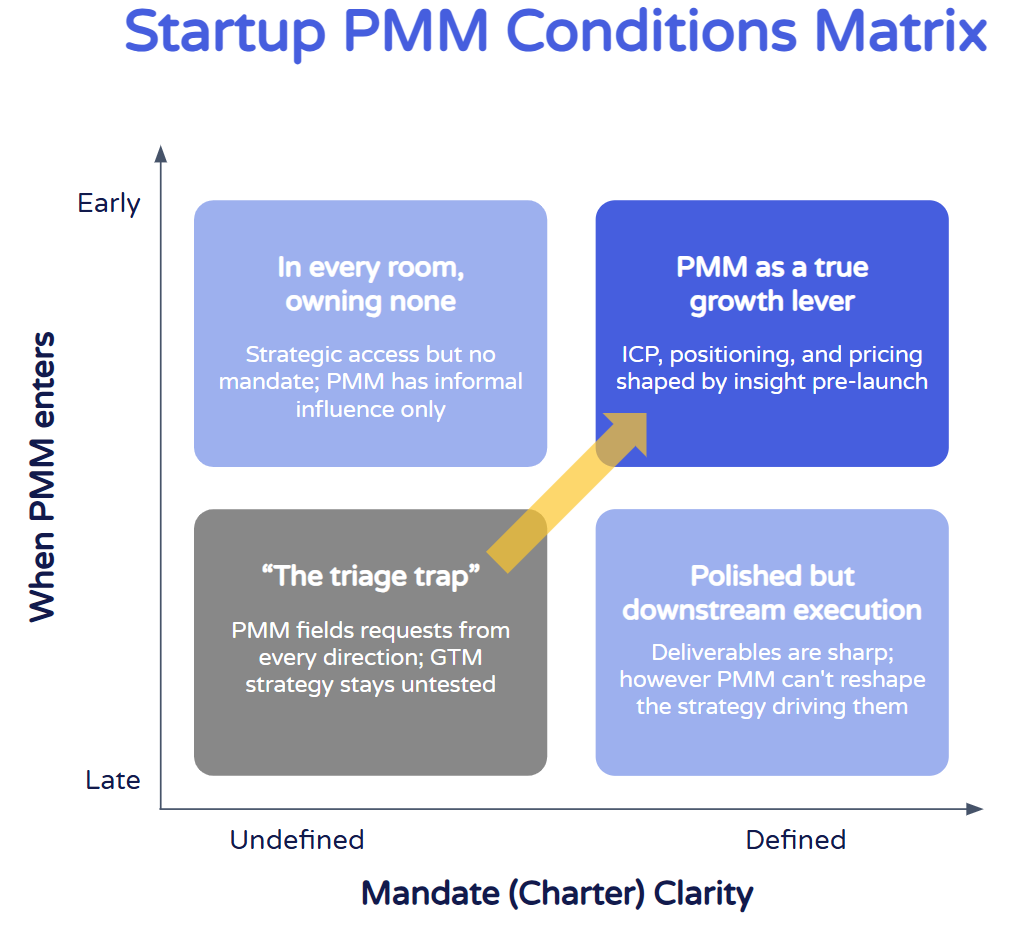
The triage trap (bottom-left) is the most common starting point. Often, the PMM is the first marketing hire. There's no GTM strategy to inherit because one hasn't been built yet, so the PMM is fielding competitive questions from sales, writing launch copy for product, running customer interviews, and standing up a website; all simultaneously, all reactively. Every team has urgent needs, and there's no system to prioritize against. What doesn't happen is the strategic work that would give all of that effort a through-line: testing positioning, validating ICP assumptions, building a repeatable launch process. The PMM is likely capable, but the accelerated and chaotic conditions don't leave room for them to breathe.
Polished but downstream execution (bottom-right) occurs when startups bring in PMM after foundational GTM decisions are already set. The PMM knows what they own and executes on standardized launch plans, creates consistent decks, and refreshes competitive positioning on a cadence. But the ICP, pricing model, and core narrative were set before they arrived, and because those decisions feel settled, the organization isn't inclined to pressure-test them. PMM may be seeing signals, like win rates that don't match the positioning or buyer objections that suggest a different value hierarchy, but sans authority to revisit foundational assumptions, growth opportunity stagnates.
In every room, owning none (top-left) PMMs don’t own their own role’s charter. Positioning and messaging have been owned by founders or product leaders up to this point, and letting go is hard. The PMM reports into one function; Product, Marketing, Chief of Staff, or even the CEO; and gets pulled in by those respective priorities instead of being able to operate truly cross-functionally. They're contributing tactically and strategically everywhere, but the work remains ad-hoc or one-off and doesn’t compound into a single go-to-market mission. Six months in, no one can measure the PMM’s efficacy because there was never a shared definition of what success should look like.
PMM as growth lever (top-right) is what becomes possible when both conditions are optimized. PMM enters early enough to shape ICP, positioning, and pricing before those decisions are locked in, and a defined charter makes clear what PMM owns versus what it informs. Critically, this quadrant also requires cross-functional buy-in and real change management authority; product, sales, and leadership have to be willing to let PMM's findings influence decisions, not just inform slide decks. PMM success doesn't require a large team or years of built-up process. It requires one well-placed team member with the right timing, a defined scope, and organizational permission to act on what they learn.
Most startups begin in the bottom-left. The goal is to move deliberately along both axes toward the top-right.
Diagnosing Your Startup’s Product Marketing Challenges with the Conditions Matrix
At what point in your GTM decision-making will PMM have a seat? If the answer is "after we've figured out what we're building and who we're selling to," you're in the bottom row. Those early decisions need to be reopened once PMM is on board. When they aren't, the company locks in untested market assumptions; and every launch, campaign, and sales conversation built on top of them carries the same blind spots forward.
Could a new PMM describe their job meaningfully on day thirty? They don't need to preemptively know every future deliverable, but they should be able to articulate the strategic center of gravity: what they own, what they influence, and what they're measured against. If that answer is unclear, you're in the left column. Without a clear functional mandate via a concrete charter, the company burns through PMM talent and budget while the same GTM gaps persist from one hire to the next.
Are your expectations for PMM calibrated to the conditions you've built? If you're expecting strategic impact but the timing is late and the charter is undefined, there's a structural mismatch between the outcome you want and the environment you've created. That mismatch doesn't resolve itself with a different hire. It resolves when the conditions and support change.
Building the right conditions for PMM as a growth lever
At maximum operational excellence, product marketing is the primary avenue for translating customer understanding into growth. Most startups aren't there yet; and that's fine. But the path to getting there is clearer than it looks.
When PMM isn't delivering the impact everyone hoped for, the instinct is to look for a different hire. The more productive move is to examine the conditions PMM is operating in. Timing and charter are both within leadership's control. They don't require a bigger budget or a more experienced team. They require a concerted conversation before the investment is made.
Many startups find that an outside perspective compresses the learning curve and reduces structural risk: someone who's built PMM functions across stages and can calibrate what "good" looks like at yours. That's the work Fluvio does. If you're evaluating where product marketing fits at your current stage, our GTM Assessment is designed to surface exactly these gaps and give you a clear picture of where to focus.