

From SEO to AEO: How PMM Leaders Should Rethink Discoverability in an AI-First World
Buyers are using AI to research your product. Most marketing strategies weren't built for that.
WRITTEN By Fluvio consultant, Kina Lara
Here's a scenario that's playing out more often than most marketing teams realize.
A buyer has a problem. Maybe their sales team is struggling to get consistent messaging across a complex product line, or they need a better way to manage customer onboarding at scale. They don't open Google and start browsing anymore. They open ChatGPT, Claude, or Perplexity and type something like: "What's the best platform for managing B2B customer onboarding?"
They get an answer. Not ten blue links to click through, but a synthesized response that names specific vendors, explains what each does, and offers a comparison. The buyer reads it, forms a first impression of the landscape, and starts narrowing their list.
Your company may or may not be in that answer. And if you appear at all, how you're described may or may not reflect what you actually do or why you're different.
This is the discoverability challenge that product marketers need to be thinking about right now.
The shift that's already happened
Most PMM teams have spent years optimizing for Google. Ranking higher. Driving more clicks. Getting content in front of buyers before they talk to a competitor. That work still matters. But the ground has shifted under it.
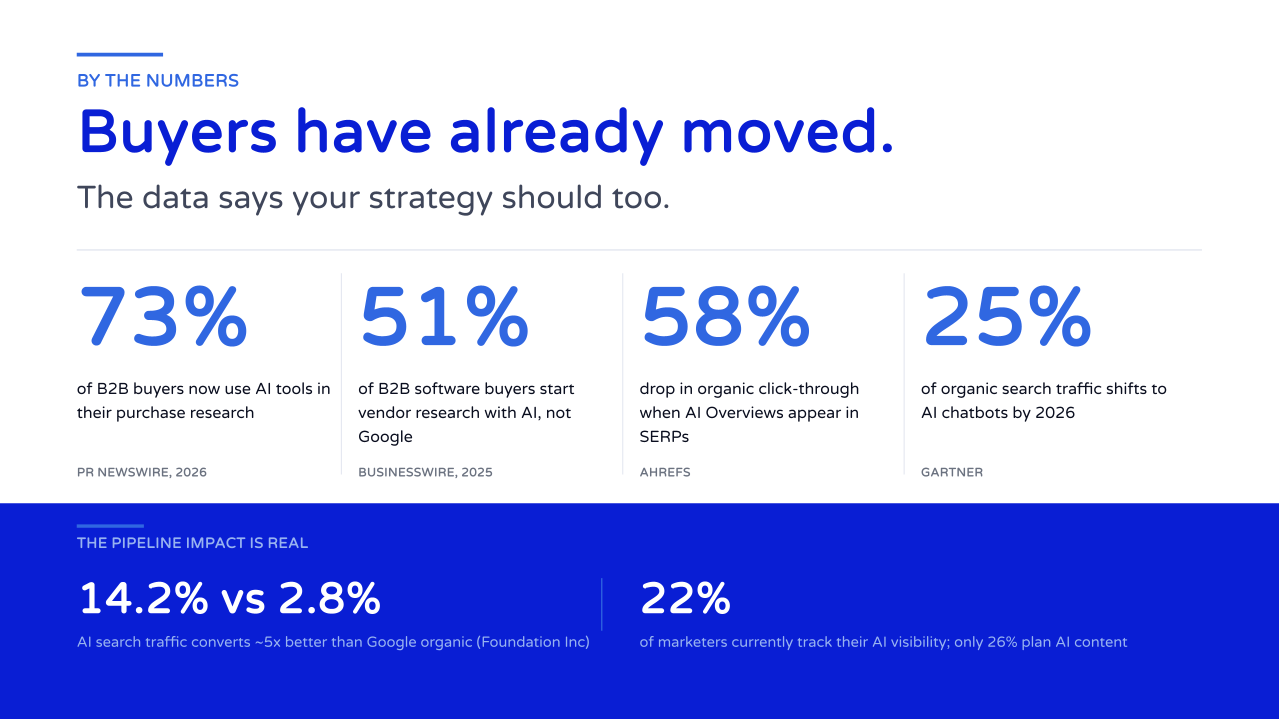
According to a March 2026 analysis of over 680 million citations, 73% of B2B buyers now use AI tools like ChatGPT and Perplexity in their purchase research. More pointedly, 51% of B2B software buyers now start their vendor research with an AI chatbot more often than with Google.
At the same time, Google itself has changed. Google's AI Overviews (the AI-generated summaries now appearing at the top of search results) have reduced organic click-through rates by as much as 58% for affected queries. Buyers are getting answers without ever visiting your site.
What this means practically: the top of the buyer's funnel has moved. The moment when a buyer forms their first impression of your category, your competitors, and your company is increasingly happening inside an AI tool. Not on your website, not on a landing page you control, and not through content you've carefully optimized for a specific keyword.
That's the core challenge. And it requires a different kind of marketing response.
SEO vs. AEO: what's the actual difference?
SEO, or search engine optimization, is about getting your content to rank high enough that buyers click through to your site. The goal is visibility, and you measure it through rankings, traffic, and conversions.
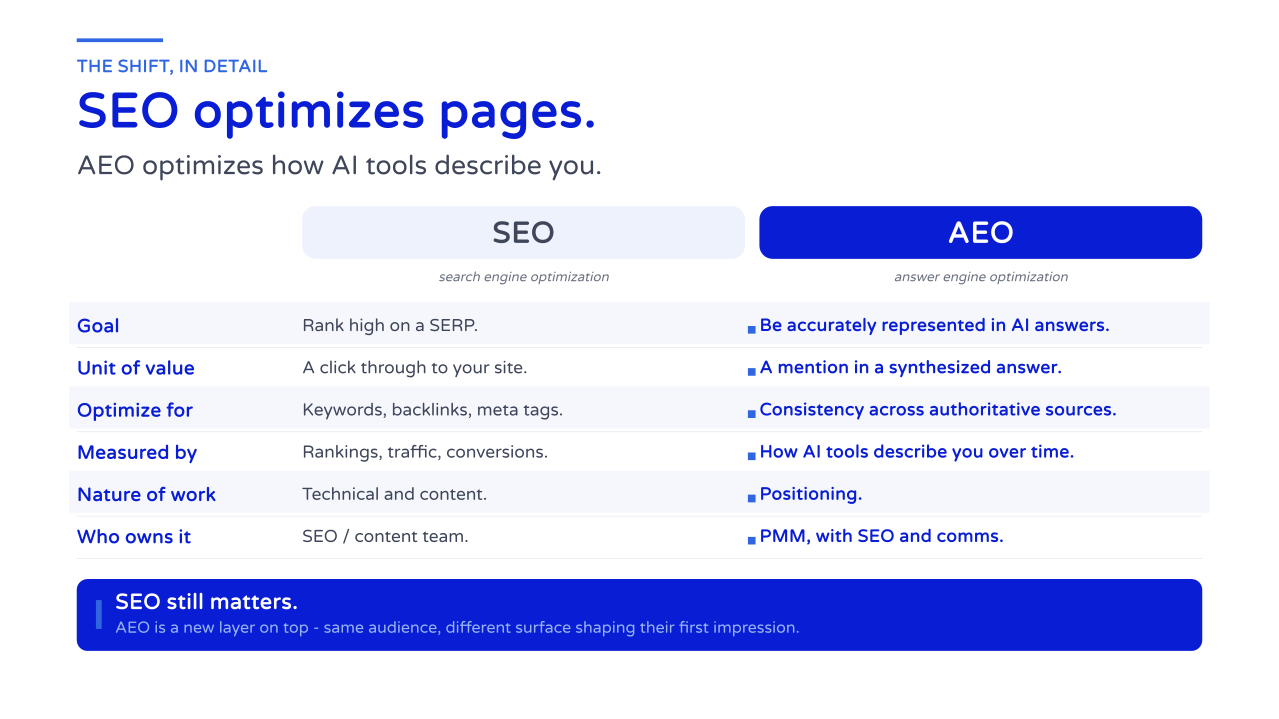
AEO, or answer engine optimization, is about making sure your company is accurately and favorably represented in AI-generated answers. The goal isn't just to show up. It's to show up with the right framing, in the right category, described in a way that reflects your actual differentiation.
That distinction matters because these are fundamentally different problems.
SEO is largely a technical and content challenge: structure your pages correctly, build the right links, publish content that matches search intent. You can outsource a lot of it to an SEO team or agency.
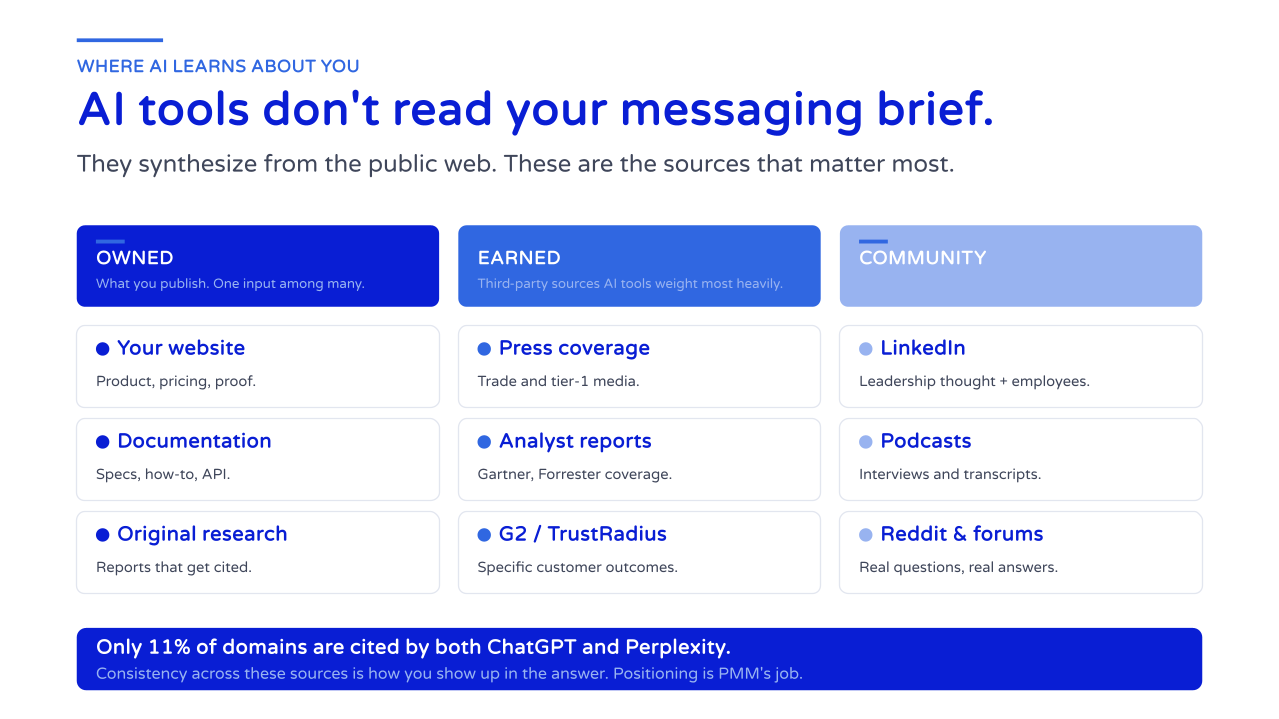
AEO is a positioning challenge. When an AI tool synthesizes an answer about your category, it draws on everything it has been trained on: your website, yes, but also press coverage, analyst reports, customer reviews on G2 and TrustRadius, LinkedIn thought leadership, podcast transcripts, community discussions, and competitor content. The "answer" a buyer receives reflects all of that combined.
If your positioning language is inconsistent across those sources, AI tools will reflect that inconsistency. If your differentiation is unclear or underdocumented in third-party content, AI tools won't be able to articulate it clearly. If competitors have built a stronger presence across the sources AI draws from, buyers will hear their story more than yours.
Positioning is PMM's job. That makes AEO a PMM problem.
Why this matters more than most PMM teams currently acknowledge
Only 22% of marketers currently track their AI visibility. Fewer than 26% have plans to create content specifically designed for AI discovery.
That gap is significant, because buyers are already there. Forrester's research shows that 61% of the buying journey is completed before a buyer ever contacts a vendor. When AI tools are accelerating and shaping that pre-contact research, the impressions buyers form before they ever talk to your sales team are increasingly influenced by how AI represents you, not by the carefully crafted messaging on your website.
There's also a performance case. AI search traffic converts at 14.2%, compared to 2.8% for Google organic. Buyers coming from AI-generated answers are more informed, more intentional, and closer to a decision. Getting your company represented accurately in that channel isn't just a brand exercise. It has a direct pipeline impact.
Gartner projects that by 2026, 25% of organic search traffic will shift to AI chatbots and virtual assistants. That's not a distant forecast. It's essentially now.
How AI tools form their opinions about your company
Understanding this helps you know what to actually fix.
AI tools don't read your messaging brief. They learn from the totality of public content that references your company, synthesizing an understanding from whatever is most available, most consistent, and most credible across the web.
That means a few things in practice:
Consistency matters a lot. If your positioning language varies across your website, your press mentions, your review site profiles, and your sales content, AI tools will reflect that inconsistency. They don't know which version of your story is "right." They average what they've seen. The more consistently your differentiated language appears across authoritative sources, the more accurately it will appear in AI answers.
Third-party sources carry more weight than your own website. Analyst coverage, customer reviews, earned media, partner content — these aren't just nice to have. They're often the primary inputs that shape AI representation. Research from G2 shows that review platforms, community sites, and analyst content are disproportionately cited in AI-generated vendor comparisons. A company with a polished website but thin third-party presence will consistently be underrepresented.
Different AI tools pull from different sources. ChatGPT and Perplexity, for example, pull from very different source ecosystems; only 11% of domains are cited by both. That means you can't optimize for a single platform and assume visibility everywhere.
Original research travels far. Content that gets cited, like industry reports, original data, named frameworks, creates the kind of multi-source presence that AI models treat as authoritative. This is why Fluvio's own research reports, like the 2026 PMM Revenue Impact Survey, generate ongoing visibility beyond their initial publication. When external sites cite your research, AI systems encounter your ideas and your company name in contexts that signal credibility.
The AEO audit: start here
Before you rebuild anything, you need to know where you actually stand. The most useful audit you can run is also the most direct: open the tools your buyers use and ask them what they think of you.
Start with four types of queries that mirror real buyer behavior:
Problem-first: "What's the best solution for [the core problem you solve]?"
Category: "What are the leading [your category] platforms?"
Comparison: "How does [your company] compare to [key competitor]?"
Validation: "What do customers say about [your company]?"
Run these across ChatGPT, Claude, Perplexity, and Google AI Overviews. Document what you find. You're looking for five things:
Do you appear at all? If not, that's your first problem.
Is the description accurate? Does it reflect your real differentiation, or something generic?
Are you in the right category? This matters more than it sounds. Category placement shapes how buyers evaluate you.
Who are you positioned next to, and how? The competitive framing in AI answers shapes early buyer mental models.
Is there any credible proof? Are customer outcomes, third-party validation, or analyst recognition part of how you're described?
Most teams that run this audit find meaningful gaps between how they position themselves and how AI tools describe them. That gap is where your work starts.
What to actually fix
Closing the gap between your intended positioning and how AI tools represent you isn't a quick project, but it's also not as overwhelming as it might seem. Focus on these areas.
Get your positioning language into third-party sources
Your website is one input. The places AI tools trust most (analyst profiles, G2 and TrustRadius pages, earned media, industry publications) are where your positioning needs to live just as clearly. Audit how you're described across those surfaces and update anything that's outdated, generic, or inconsistent with your current differentiation.
Build content that's worth citing
AI tools favor structured, specific, authoritative content, especially content that directly answers the questions buyers are researching. This doesn't mean writing for AI. It means writing genuinely useful content: clear explanations of the problems you solve, honest comparisons with alternative approaches, original data and frameworks that give other writers something worth referencing. HubSpot's AEO research found that brands leading in AI visibility update their content regularly and structure it around the questions buyers actually ask, not just the keywords they've historically targeted.
Invest in earned presence, not just owned content
Press coverage, analyst relationships, community participation, and guest contributions in industry publications have always mattered for brand building. In an AEO context, they're also the sources AI tools draw from most heavily. A sustained PR and analyst relations strategy that generates genuine citations in authoritative publications is one of the most durable investments you can make in AI discoverability.
Make customer proof specific and findable
Vague testimonials don't help AI tools understand what you do or who you serve. Specific case studies that name the problem, the use case, and the measurable outcome give AI systems material to work with. Review the customer proof on your website and across review platforms. Prioritize specificity over polish.
Match your language to how buyers actually describe the problem
There's often a gap between the vocabulary companies use to describe their product and the language buyers use when they're searching for a solution. AI tools will reflect buyer language, not internal jargon. If your positioning document uses terminology that buyers don't use when they're in early-stage research mode, you may be invisible in the conversations that matter most.
How to measure whether it's working
AEO measurement is newer than SEO measurement, and the tooling is still catching up. But there are practical signals you can track today.
Run the same AI queries monthly. It takes less time than you'd think, and tracking changes in how you're described over time gives you a real sense of whether your efforts are moving the needle. Document it consistently, so you can see the trends.
Monitor third-party citation volume. Are more authoritative sources referencing your research, your frameworks, your company? This is a leading indicator of AI discoverability and tends to precede improvement in how AI tools represent you.
Ask buyers where they first encountered you. Sales conversations, onboarding calls, and win/loss interviews are underused sources of discovery data. AI-sourced discovery is increasingly mentioned in these conversations. Make it a standard question, so you know how often buyers are finding you through AI tools before they ever reach your site.
Watch early-funnel conversation quality. Buyers who've been shaped by accurate AI answers arrive in conversations more informed. They understand your category, know roughly how you compare to alternatives, and have already cleared some of their early questions. If that's happening more often, it's a sign your AI representation is improving.
The bigger opportunity
AEO isn't a replacement for SEO, and it's not a purely technical problem to hand off to your web team. It's an extension of what product marketing has always been responsible for: making sure the market understands who you are, what you do, and why it matters.
What's changed is where that understanding forms. The top of the funnel is increasingly inside an AI tool. And the PMM teams who figure out how to show up there, with accuracy and real credibility behind them, will have a meaningful advantage over the ones still optimizing for a world that's already shifted.
The good news is that most of what drives AI discoverability is the same work that drives strong GTM more broadly: clear positioning, consistent messaging, genuine thought leadership, strong customer proof, and a presence in the external sources your market actually trusts. If your GTM foundation is solid, you're not starting from scratch. You're extending what's already working into a new surface.
If you're not sure whether your current GTM motion is built for this kind of discoverability, or where the gaps might be, Fluvio's GTM Assessment is a good place to start.